

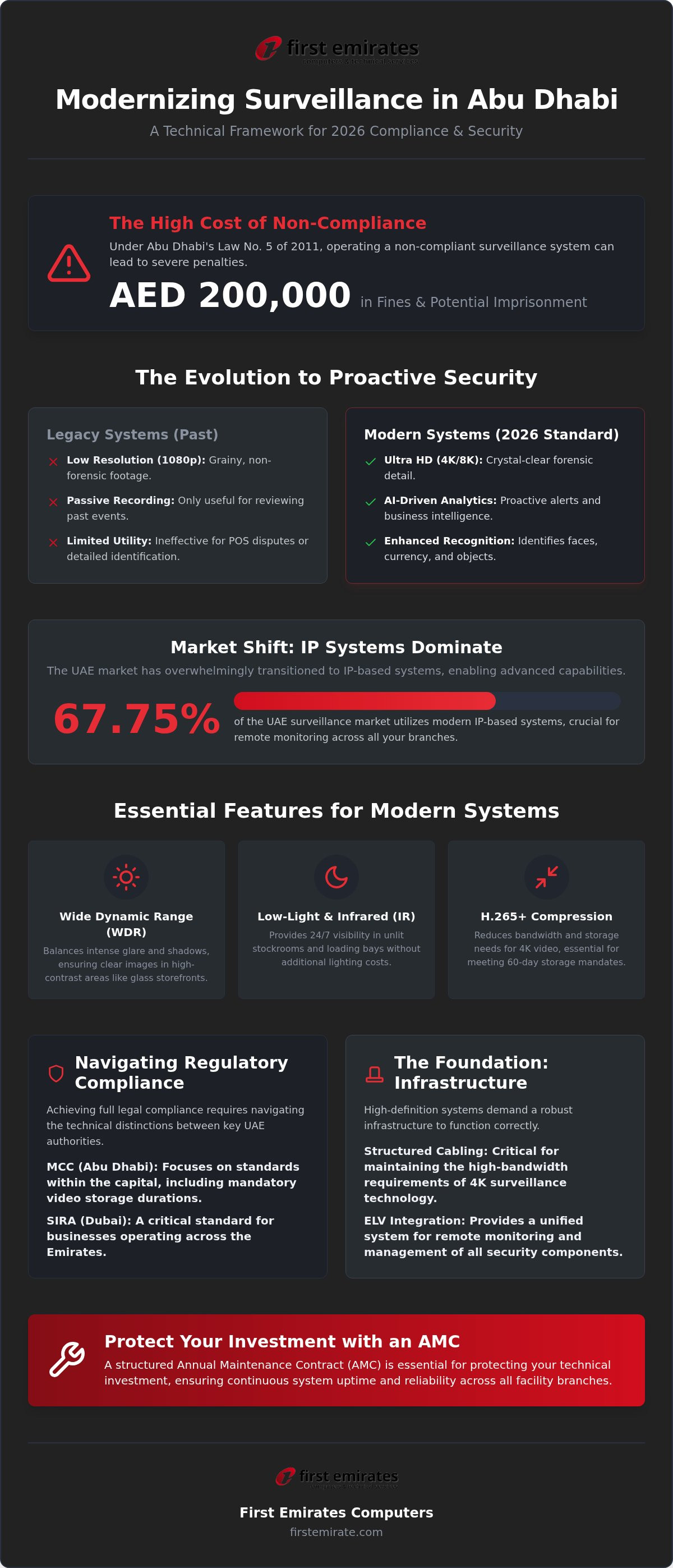
Operating a non-compliant surveillance system in Abu Dhabi can lead to fines as high as AED 200,000 and potential imprisonment under Law No. 5 of 2011. For business owners managing large retail spaces or industrial sites, the risk of inventory shrinkage is often compounded by the fear of government penalties for technical oversights. You've likely experienced the frustration of grainy footage during a POS dispute or the complexity of maintaining CCTV for warehouses Abu Dhabi that satisfies the Monitoring and Control Centre (MCC) standards. It's a significant operational burden that requires a methodical, technical solution rather than just another set of cameras.
This guide provides a comprehensive framework for deploying high-definition surveillance and AI-driven analytics in 2026. You'll learn how to achieve full certification for your facility while utilizing crystal-clear facial recognition to protect your assets, ensuring your system meets both MCC and SIRA-approved standards. We'll outline the transition to IP-based systems, which currently dominate 67.75% of the UAE market, and explain how integrated ELV projects provide remote monitoring for all your branches. By following this systematic approach, you can eliminate security blind spots and ensure your warehouse remains a secure, compliant, and optimized environment.
Key Takeaways
- Understand the transition from 1080p to 4K standards to ensure your surveillance provides the forensic detail required for modern retail loss prevention.
- Navigate the technical distinctions between MCC and SIRA regulations to maintain full legal compliance and adhere to mandatory storage durations in Abu Dhabi.
- Implement a methodical security framework for CCTV for warehouses Abu Dhabi that integrates AI-driven analytics to proactively manage inventory and site access.
- Learn why professional structured cabling and ELV integration are critical for maintaining the high-bandwidth requirements of 2026 surveillance technology.
- Identify how structured Annual Maintenance Contracts (AMC) protect your technical investment and ensure continuous uptime across multiple facility branches.
The Evolution of High-Definition CCTV for Retail and Warehouse Surveillance
The technical landscape of Closed-circuit television (CCTV) has undergone a systematic transformation. By 2026, the standard for professional surveillance in the UAE has shifted from 1080p toward 4K and 8K resolutions. This evolution is driven by the need for forensic clarity in both retail environments and industrial zones. Passive surveillance, which merely records events for later review, is no longer sufficient for modern retail loss prevention. High-definition (HD) systems provide the foundational data needed for proactive security. In large-scale facilities, the strategic advantage of HD lies in its ability to monitor vast floor spaces without sacrificing the minute details required for evidence. Crystal-clear footage is no longer just a security requirement; it serves as actionable business intelligence for optimizing inventory workflows.
Resolution vs. Recognition: The Megapixel Requirement
Selecting the correct resolution is a functional decision based on the specific needs of the facility. While 4MP cameras are often adequate for general area monitoring, 8MP (4K) sensors are essential for identifying currency denominations at point-of-sale terminals or facial features at entry points. High-resolution sensors allow for effective digital zoom, ensuring that evidence quality remains high during a forensic review of an incident. Pixel density is the primary technical metric that determines whether a system can successfully identify suspects within the expansive Musaffah industrial zones. A methodical installation of CCTV for warehouses Abu Dhabi provides the necessary clarity to meet both internal security goals and external regulatory standards. This level of detail is critical when presenting evidence for MCC or SIRA compliance, where identification is more important than simple detection.
AI-Driven Analytics in HD Surveillance
The integration of AI-driven analytics relies entirely on the quality of the visual feed. HD cameras allow software to perform heat mapping and customer flow analysis with high precision, helping retail managers understand shopping patterns. In industrial settings, these feeds enable automated alerts for unusual activity in warehouse loading bays, such as unauthorized vehicle movements or personnel in restricted zones. Object detection algorithms use high-definition data to identify left-behind packages or missing inventory units in real-time. Implementing robust CCTV for warehouses Abu Dhabi ensures that these automated systems have the clarity needed to reduce false alarms. By utilizing HD feeds, businesses can move beyond simple monitoring toward a comprehensive management system that supports both security and operational efficiency.
Essential Technical Features for Modern Warehouse and Retail CCTV Systems
High-definition resolution is only effective when supported by specialized hardware features that address environmental challenges. In Abu Dhabi, retail storefronts often face intense natural glare from expansive glass fronts. Wide Dynamic Range (WDR) technology is essential here; it balances lighting across high-contrast areas to ensure faces remain visible against bright backgrounds. For unlit stockrooms and large loading bays, Low-light and Infrared (IR) technology provides 24/7 visibility for CCTV for warehouses Abu Dhabi without requiring additional lighting expenditure. These Essential Technical Features for Modern Warehouse CCTV allow for consistent monitoring regardless of time or weather conditions.
Managing the data generated by 4K video requires advanced H.265+ compression. This codec optimizes storage by reducing bandwidth requirements without degrading image quality. It's a critical component for facilities needing to meet the 60-day storage requirements often mandated in the UAE. For retail counters, audio integration is increasingly utilized to resolve disputes during point-of-sale transactions. A methodical approach to hardware selection ensures that every technical feature serves a specific functional purpose.
Optimizing Form Factors for Specific Zones
Different areas of a facility require specific camera shapes to maximize effectiveness. Dome cameras are the preferred choice for retail aisles because they provide a discreet profile that blends into the ceiling. In contrast, bullet cameras serve as a high-visibility deterrent when used for CCTV for warehouses Abu Dhabi. These are ideal for long perimeters and high-ceiling storage areas. For total floor coverage in open spaces, 360-degree fisheye cameras eliminate blind spots by replacing multiple fixed cameras with a single panoramic view.
Advanced Video Management Systems (VMS)
A robust Video Management System (VMS) acts as the central intelligence hub for surveillance. It allows for centralized monitoring across multi-branch retail operations, providing a unified view of all Abu Dhabi locations from a single headquarters. Mobile access ensures that managers can securely view HD feeds on tablets or smartphones while off-site. To prevent unauthorized access, these systems must utilize rigorous cybersecurity protocols. Coordinating these systems with professional IT AMC services Abu Dhabi ensures your VMS remains updated against emerging digital threats.
Navigating SIRA and MCC Regulatory Compliance in Abu Dhabi
Regulatory compliance for surveillance in the UAE is governed by specific regional authorities that mandate strict technical standards. In Abu Dhabi, the Monitoring and Control Centre (MCC) oversees all systems under Law No. 5 of 2011. While the Security Industry Regulatory Agency (SIRA) manages Dubai, businesses often choose to partner with a SIRA approved CCTV company Abu Dhabi that understands the nuances of both frameworks. This is particularly relevant for companies with operations across multiple emirates. Non-compliance isn't just a technical oversight; it carries significant legal risks, including fines ranging from AED 50,000 to AED 200,000. Maintaining a system that meets these standards is essential for the legal operation of CCTV for warehouses Abu Dhabi.
To be admissible as evidence, footage must meet minimum technical specifications defined by the MCC. These regulations typically require high-definition resolution and specific frame rates to ensure that motion is captured without blurring. Storage duration is another critical metric for compliance. While 31 days has been the historical baseline, many industrial and high-value retail facilities in 2026 must adhere to 60-day storage requirements. This ensures that historical data remains available for government audits or police investigations. A methodical approach to system design ensures that your storage capacity matches these legal mandates without compromising video quality.
Critical Monitoring Zones for Legal Compliance
Compliance begins with the strategic placement of cameras in mandatory monitoring zones. For retail environments, every Point of Sale (POS) must have dedicated coverage that captures transaction details and cash handling with absolute clarity. Entry and exit points require high-resolution sensors capable of identifying every person entering the facility. In industrial areas like Musaffah, perimeter security is a primary focus for MCC inspectors. Implementing robust CCTV for warehouses Abu Dhabi involves securing these boundaries with cameras that provide clear identification even in challenging outdoor lighting. These zones are the first areas checked during a government inspection.
Audit Preparation and System Certification
System certification requires a systematic approach to documentation and hardware maintenance. Government inspectors evaluate the placement, resolution, and uptime of every camera in the network to ensure the system remains functional. Partnering with a methodical integrator ensures that your hardware longevity meets these recurring certification cycles. High-definition footage is the primary tool for obtaining police reports after an incident, making technical readiness a core business priority. Keeping your system certified doesn't just avoid fines; it provides a reliable foundation for business continuity and insurance claims in the event of inventory loss.
Infrastructure Integration: ELV Systems and Structured Cabling
A common technical oversight in security planning is treating cameras as standalone hardware. High-definition video performance is fundamentally dependent on the underlying network infrastructure. Professional structured cabling services UAE provide the high-bandwidth pathways required to transmit 4K and 8K streams without packet loss. For expansive facilities, such as those requiring robust CCTV for warehouses Abu Dhabi, the choice of cabling determines the system's overall reliability. Utilizing Power over Ethernet (PoE) technology further streamlines these setups by delivering both data and electrical power through a single cable, which is particularly advantageous for clean, efficient retail installations.
Unified ELV project management is essential for new warehouse constructions. It ensures that surveillance, networking, and security systems are designed as a single, cohesive unit rather than a collection of disparate parts. This methodical approach reduces installation costs and simplifies future maintenance. By integrating these systems during the initial build phase, businesses avoid the technical limitations of retrofitting infrastructure into established layouts.
The Backbone: Cat6 and Fiber Optic Solutions
Standard network cables often face signal degradation over the long distances found in industrial storage sites. Implementing Cat6 or fiber optic solutions is essential for future-proofing retail and warehouse networks against the increasing data demands of 2026. These materials reduce latency and ensure that HD feeds remain fluid during real-time monitoring. Businesses should consult a structured cabling companies in Abu Dhabi guide to understand the specific infrastructure specs required for their facility size. A methodical backbone installation prevents the choppy video and connection drops that frequently plague uncertified setups.
Unified Security: CCTV and Access Control Synergy
Integrating surveillance with biometric access control systems UAE creates a comprehensive ELV ecosystem. This synergy allows security managers to link specific video events directly to door access logs, which is a critical deterrent against internal inventory theft. If an unauthorized entry occurs, the system can trigger automated lockdown procedures based on AI-detected intrusions. Managing these assets from a single workstation provides a unified view of the entire facility's security status. This integrated approach ensures that your investment in CCTV for warehouses Abu Dhabi works in tandem with physical entry barriers. To begin planning your integrated facility security, contact First Emirates Computers for a professional technical consultation.
Implementing a Methodical Security Framework with First Emirates Computers
Since 2011, First Emirates Computers has established itself as a steady hand in Abu Dhabi’s complex technical landscape. We don't just sell hardware; we implement disciplined frameworks designed for long-term reliability. A successful deployment of CCTV for warehouses Abu Dhabi begins with a methodical site survey and a rigorous risk assessment. These evaluations identify vulnerable points in complex retail layouts that standard transactional vendors often overlook. Our role is to act as a dependable, long-term partner, ensuring your surveillance system remains a functional business asset rather than a technical liability.
Maintaining retail continuity requires more than just high-quality cameras. It demands structured IT AMC services Abu Dhabi to guarantee maximum uptime. These maintenance contracts provide the technical readiness needed to address hardware failures or network bottlenecks before they result in security gaps. We also provide comprehensive staff training on VMS operation and evidence retrieval protocols. This ensures your team can quickly identify and export footage during a dispute or theft investigation, following the exact procedures required for police admissibility in the UAE.
Annual Maintenance: Beyond Simple Repairs
Professional maintenance involves a disciplined schedule of technical checks that go beyond basic troubleshooting. Our team performs quarterly lens cleaning and storage health audits to ensure your system is always ready for a forensic review. In the industrial environments of Musaffah, physical maintenance is critical for maintaining video clarity against dust and heat. We also manage firmware updates to protect your integrated ELV assets against emerging cybersecurity threats. As security regulations evolve, our AMC ensures your system remains compliant with mandatory storage durations, such as the 60-day requirement for high-value facilities.
The "Capability-First" Architecture for Technical Projects
Our methodical approach prioritizes the scope of professional responsibility through what we call a "capability-first" architecture. We ensure that the installation of CCTV for warehouses Abu Dhabi causes minimal business disruption by scheduling work during off-peak hours and using systematic cabling techniques. This strategy ensures that new surveillance feeds don't interfere with your existing retail or warehouse networks. We provide scalable solutions that grow with your business footprint. Whether you're expanding a single boutique or a large-scale distribution center, our integrated systems provide a stable foundation for inventory protection and operational oversight.
Securing Your Operational Future through Technical Precision
Transitioning to 4K resolution and ensuring full MCC compliance are no longer optional for Abu Dhabi businesses; they're foundational requirements for modern operations. Integrated ELV systems and structured cabling provide the necessary infrastructure to manage high-bandwidth video data while maintaining retail continuity. Implementing a robust strategy for CCTV for warehouses Abu Dhabi ensures your inventory remains protected and your facility adheres to the latest legal mandates without the risk of government fines.
First Emirates Computers has served as a steady partner in the UAE technical sector since 2011. Our methodical approach focuses on the professional integration of Hikvision, UNV, and Dahua systems, ensuring every installation meets rigorous standards. With dedicated Annual Maintenance Contracts, we provide the ongoing support needed for 24/7 reliability in demanding industrial and retail environments. It's time to move beyond passive monitoring toward a comprehensive, compliant security framework. Consult with First Emirates Computers for a SIRA-compliant security assessment to verify your technical readiness. Building a secure environment today provides the stability your business needs for long-term growth.
Frequently Asked Questions
What is the minimum resolution required for retail CCTV in Abu Dhabi by SIRA?
While SIRA is the primary regulatory body in Dubai, its standards often influence regional technical benchmarks. For standard retail monitoring, a minimum resolution of 1080p is generally required to ensure basic identification. However, the Monitoring and Control Centre (MCC) in Abu Dhabi often mandates higher specifications for cash-handling areas. You should ensure your system supports at least 2MP to 4MP for forensic clarity. This level of detail is essential for meeting both local legal standards and insurance requirements.
How long must a warehouse in Musaffah store its CCTV footage according to UAE law?
Under Abu Dhabi MCC regulations and Law No. 5 of 2011, warehouses are typically required to store footage for at least 31 days. However, for high-security facilities and large-scale industrial sites in 2026, this requirement has shifted toward a 60-day mandate. It's vital to configure your CCTV for warehouses Abu Dhabi with sufficient storage capacity to avoid overwriting data. Compliance with these durations is a prerequisite for passing government inspections and maintaining your facility's operational license.
Can high-definition CCTV help reduce insurance premiums for UAE businesses?
Implementing a high-definition surveillance system can lead to lower insurance premiums for businesses in the UAE. Insurers view professional CCTV as a critical risk mitigation tool that reduces the likelihood of successful theft or fraudulent claims. By providing clear, timestamped evidence, you lower the insurer's liability and demonstrate a methodical approach to security. Many providers offer specific discounts to facilities that maintain valid certification and active maintenance contracts with an approved technical partner.
What is the difference between IP cameras and Analog HD for retail environments?
IP cameras transmit digital signals over structured cabling, offering superior resolution and advanced AI features like heat mapping. Analog HD systems use coaxial cables and are often more cost-effective for small, legacy setups but lack the scalability of modern digital networks. For retail environments in 2026, IP systems are the standard because they integrate with other ELV assets. They provide the bandwidth necessary for 4K video and allow for secure remote monitoring across multiple branch locations.
Do I need a SIRA-approved company for a small boutique in Abu Dhabi?
Yes, even small boutiques must utilize a licensed and approved company to ensure their surveillance system meets government standards. Regulatory bodies require all installations to be performed by approved integrators to maintain public safety and data privacy protocols. Using a non-approved provider can lead to significant fines or complications during trade license renewals. It's a professional necessity to ensure your hardware is registered and compliant with the Monitoring and Control Centre's specific technical requirements.
How does lighting affect 4K camera performance in deep warehouse aisles?
High-resolution 4K cameras require sufficient light to maintain forensic detail in the deep aisles of a large facility. While 4K sensors provide a high pixel count, they can struggle in low-light conditions compared to sensors with larger individual pixels. To ensure your CCTV for warehouses Abu Dhabi remains effective, you should select cameras with advanced infrared or low-light technology. These features allow the system to capture clear images in unlit storage areas without excessive digital noise or motion blurring.
What are the benefits of integrating CCTV with my Point of Sale (POS) system?
Integrating surveillance with your POS system allows you to overlay real-time transaction data directly onto your video feeds. This synergy is invaluable for resolving customer disputes and identifying internal fraud or cash-handling errors. It creates a searchable database where you can find video clips based on specific transaction IDs or amounts. This methodical approach to retail management transforms your security system into a powerful tool for financial auditing and daily operational oversight.
Is cloud storage or an on-site NVR better for managing retail video data in the UAE?
On-site Network Video Recorders (NVR) are generally better for managing high-definition retail data due to bandwidth requirements and local compliance laws. Local storage ensures your system meets mandatory duration requirements without relying on an external internet connection. However, many businesses now adopt a hybrid approach that uses cloud storage for critical backups. This strategy provides an extra layer of protection, ensuring your most important evidence remains safe even if the physical hardware is damaged or stolen.


