

Operating a commercial facility in Abu Dhabi without MCC-approved monitoring can lead to fines reaching AED 200,000 and potential imprisonment. You're likely aware that maintaining commercial security system compliance UAE is no longer just about mounting cameras; it's about meeting the rigorous technical standards required for 2026. The anxiety of facing heavy SIRA penalties or discovering that your aging hardware is obsolete during a licensing audit is a constant pressure for many business owners. Fragmented systems that fail to communicate often leave gaps in your operational readiness and security posture.
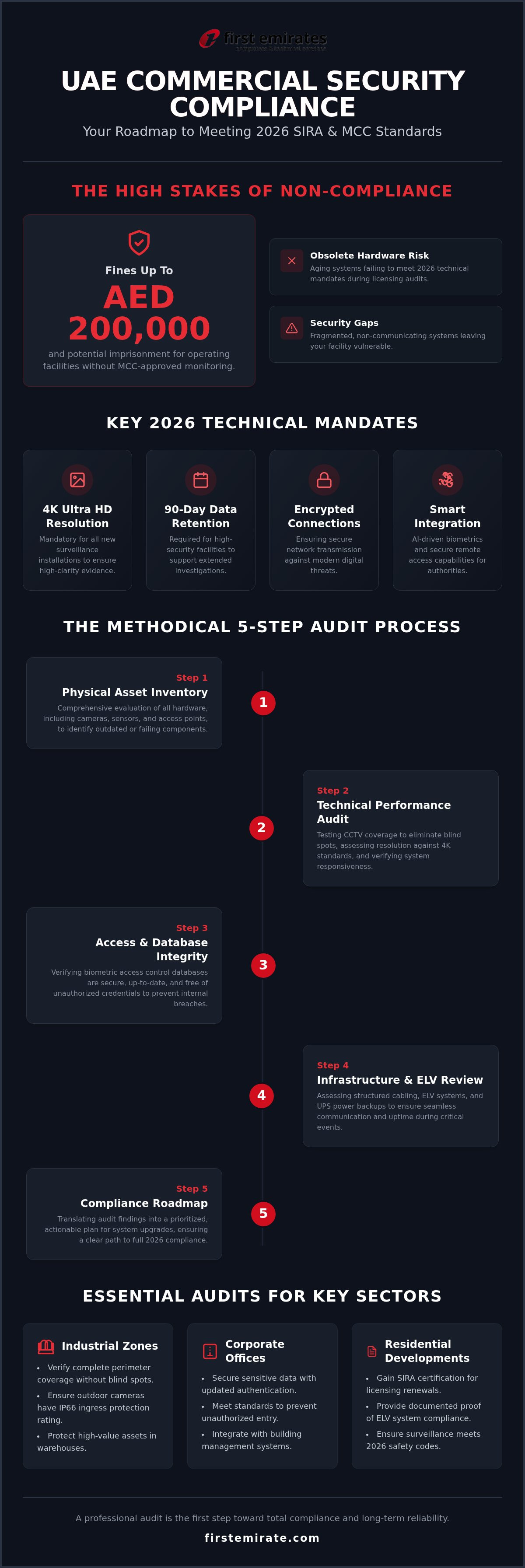
This guide provides a methodical framework to evaluate your physical infrastructure and digital integration. We'll show you how to move from uncertainty to total compliance. We'll detail the exact 2026 requirements for 4K resolution, the 90-day data retention mandates for high-security facilities, and the necessity of encrypted connections. By following this structured approach, you'll gain a clear roadmap for system upgrades and the certification needed for seamless licensing. We'll examine how professional structured cabling and integrated ELV projects ensure your surveillance and access control systems function as a unified, reliable asset that protects your investment.
Key Takeaways
- Identify critical technical gaps to achieve commercial security system compliance UAE by aligning your infrastructure with 2026 SIRA and MCC standards.
- Understand the 2026 hardware mandates, including 4K Ultra HD resolution requirements and the 90-day data retention protocols for high-security facilities.
- Implement a methodical five-step audit process that evaluates physical asset inventory, technical performance, and the integrity of biometric access databases.
- Differentiate your security posture by assessing structured cabling and ELV integration to ensure seamless communication between fragmented hardware components.
- Translate audit findings into a prioritized roadmap for system upgrades and long-term reliability through comprehensive Annual Maintenance Contracts (AMCs).
Understanding the Strategic Value of a Security System Audit in the UAE
A security system audit is a methodical evaluation of a facility's hardware, its supporting IT infrastructure, and its alignment with local laws. It goes beyond checking if a camera is powered on. It examines the integrity of physical security measures to ensure every component, from structured cabling to biometric databases, functions as a unified shield. For businesses targeting commercial security system compliance UAE, this process identifies technical vulnerabilities before they become legal liabilities. It's a proactive strategy that establishes a baseline for operational readiness.
2026 marks a significant turning point for UAE security standards. While a routine maintenance check focuses on immediate repairs and cleaning, a comprehensive audit evaluates long-term viability against updated regulations. Government bodies now require specific technical benchmarks that older systems often fail to meet. An audit provides a gap analysis between your current installation and the mandatory 2026 hardware requirements. This distinction is vital for businesses that want to avoid the cycle of reactive repairs and move toward a stable, compliant infrastructure.
Primary drivers for these audits include risk mitigation, insurance requirements, and mandatory government mandates. An undetected failure in a structured cabling network can disable an entire surveillance grid during a critical incident. Insurance providers in the UAE increasingly request detailed audit reports to verify that physical security measures are sufficient before underwriting high-value assets. A professional audit provides the technical documentation required to prove your facility is a low-risk environment, providing peace of mind for stakeholders and regulators alike.
The Evolution of UAE Security Regulations
The shift from basic surveillance to integrated smart city infrastructure has redefined local requirements. By 2026, the landscape demands 4K Ultra HD resolution for new installations and 90-day data retention for high-security facilities. We're seeing a move away from standalone hardware toward AI-driven biometric access control and encrypted network transmission. These updates ensure that commercial security system compliance UAE remains robust against modern digital and physical threats. Systems must now be capable of remote access for approved authorities, necessitating a higher degree of cybersecurity than in previous years.
Who Needs a Security Audit Most?
Certain sectors face higher scrutiny due to the nature of their operations. A methodical audit is essential for the following environments:
- Industrial Zones: High-value warehouses in Musaffah require audits to verify that extensive perimeters are fully covered without blind spots and that outdoor cameras maintain an IP66 ingress protection rating.
- Corporate Offices: Abu Dhabi businesses must ensure their biometric access control protocols protect sensitive data and meet updated authentication standards to prevent unauthorized entry.
- Residential Developments: Large towers seeking SIRA certification need documented proof that their ELV systems and surveillance networks meet 2026 safety codes for licensing renewals.
The Scope of a Professional Security and ELV Audit
A professional audit must encompass every layer of the physical security stack to achieve commercial security system compliance UAE. This exhaustive process begins with a comprehensive evaluation of CCTV coverage to identify blind spots that could be exploited. We also assess biometric access control system responsiveness and database integrity to ensure that only authorized personnel move through your facility. Beyond individual devices, the audit reviews Extra Low Voltage (ELV) components and power backup systems. These Uninterruptible Power Supply (UPS) units are critical for maintaining uptime during electrical fluctuations or intentional power cuts. Testing integrated office automation triggers for emergency responses ensures that your fire and security protocols activate simultaneously when needed. This systematic approach ensures that no single point of failure compromises your entire security perimeter.
CCTV and Surveillance Integrity
Surveillance hardware in the UAE must withstand extreme temperatures and fine dust. An audit involves checking camera resolution against the 2026 4K mandate and evaluating night vision capabilities in low-light industrial areas. We verify storage redundancy to ensure recordings are preserved if a primary drive fails. You can identify top-tier providers in our access control system company selection guide. Aligning with Local Regulatory Standards: SIRA is essential for Dubai-based businesses, as inspectors look for specific hardware durability and placement accuracy. We also examine the physical condition of outdoor housings to prevent moisture ingress during the humid summer months.
Structured Cabling: The Invisible Backbone
The reliability of any security grid depends on its underlying infrastructure. We test Cat6 and Fiber optic lines for signal degradation that can cause flickering or delayed camera feeds. A thorough inspection includes server room organization and labeling, which reduces downtime during future maintenance. You can compare infrastructure experts in this structured cabling companies in Abu Dhabi comparison. A well-organized rack prevents overheating and simplifies the troubleshooting of ELV projects. Ensuring your physical assets are functionally ready is a core specialty of First Emirates Computers, where we prioritize methodical technical oversight to keep your operations running without interruption. We look for cable stress and improper bends that might compromise data transmission speeds over time.
Navigating Local Regulatory Standards: SIRA, MCC, and Beyond
Achieving commercial security system compliance UAE requires a disciplined understanding of the dual-regulator environment. While federal standards exist, the specific technical mandates often depend on the emirate where your business operates. Dubai-based entities fall under the jurisdiction of the Security Industry Regulatory Agency (SIRA), while Abu Dhabi properties must align with the Monitoring and Control Centre (MCC) guidelines. Failing to meet these standards doesn't just result in failed inspections; it can lead to significant administrative fines and delays in trade license renewals. A methodical approach to these regulations ensures your infrastructure remains a functional asset rather than a liability.
Sector-specific requirements further complicate the landscape. Retail outlets and hospitality venues face different surveillance density rules compared to industrial warehouses. For instance, exchange businesses and high-security facilities are now mandated by the Central Bank of the UAE to maintain 90 days of continuous CCTV recordings. An approved technical partner plays a critical role in pre-audit preparation. We provide the technical stress testing and system documentation required to ensure your facility is ready for official certification, bridging the gap between hardware installation and regulatory approval.
SIRA Approved CCTV Standards for Dubai
Dubai's SIRA security standards have become increasingly stringent to support the city's smart infrastructure goals. For 2026, all new installations must utilize 4K Ultra HD resolution to ensure forensic-level clarity. Storage duration is a primary focus for inspectors; while standard commercial properties typically require 31 days of data retention, high-risk sites must hit the 90-day mark. Camera placement is equally regulated. Every public-facing entrance and exit must have dedicated coverage capable of clear facial recognition. Using SIRA-certified hardware is mandatory, as non-compliant devices will be rejected during the final portal upload and inspection phase.
Abu Dhabi MCC and Industrial Compliance
In Abu Dhabi, the MCC oversees a rigorous framework for public and private facilities. Compliance is particularly vital for warehouses in Musaffah and ICAD zones, where industrial security mandates are strictly enforced. These systems must often support remote access for local authorities to ensure rapid emergency response. Operating monitoring devices without MCC approval is a high-risk oversight that can result in fines ranging from AED 50,000 to AED 200,000. To avoid these penalties during 2026 government inspections, businesses must verify that their systems don't infringe on privacy regulations, such as the prohibition of zoom lenses facing private areas like swimming pools. A structured audit confirms that your integration meets these precise local expectations.
A Methodical 5-Step Approach to Conducting Your Security Audit
Executing a systematic audit is the only way to guarantee your infrastructure meets the evolving demands of commercial security system compliance UAE. A haphazard check often misses the underlying technical issues that lead to system failure during critical incidents. Our approach is built on a disciplined, five-step framework designed to identify risks and provide a clear path to certification. This process ensures that your physical hardware and digital networks are not only functional but also fully aligned with the latest SIRA and MCC mandates for 2026.
The five essential steps of a professional audit include:
- Step 1: Physical Site Survey and Asset Inventory: A comprehensive mapping of all hardware components.
- Step 2: Technical Performance Testing and Stress Analysis: Evaluating system behavior under heavy operational loads.
- Step 3: Vulnerability Assessment and Gap Analysis: Identifying security weaknesses and regulatory shortfalls.
- Step 4: Regulatory Compliance Verification: Cross-referencing all findings with current UAE security laws.
- Step 5: Final Audit Report and Strategic Roadmap: Delivering a prioritized plan for upgrades and maintenance.
Phase 1: Physical Inspection and Inventory
A thorough physical asset inventory is the essential foundation of any reliable security audit. During this phase, we locate every camera, sensor, and controller to verify they match your official asset list. We don't just count devices; we inspect them for physical tampering or environmental damage caused by the harsh UAE climate. Fine dust and extreme heat can degrade outdoor housings and lens clarity over time. By verifying the physical integrity of your hardware, we ensure that the "first line of defense" remains robust and ready for the technical testing that follows.
Phase 2: Technical Stress Testing
Once we've verified the physical assets, we move to technical stress testing to ensure the system doesn't fail when you need it most. We simulate power failures to test the response times of your UPS and backup generators, ensuring continuous surveillance during outages. Our team tests network bandwidth under a full surveillance load to identify bottlenecks that might cause frame drops or lag in your 4K feeds. We also verify the accuracy of biometric sensors and face recognition algorithms to ensure they meet the 2026 standards for speed and reliability. This phase is critical for maintaining commercial security system compliance UAE, as it proves your system is functionally capable of protecting your premises. To ensure your facility is prepared for an official inspection, you can schedule a professional security audit with our technical specialists today.
Post-Audit Strategy: Maintenance and Long-Term Reliability
Completing a security audit is only the first stage of ensuring your facility remains protected. The true value lies in translating the raw data from your audit findings into a prioritized system upgrade roadmap. This document serves as a strategic plan to address technical debt while maintaining commercial security system compliance UAE. By categorizing necessary repairs based on their impact on licensing and safety, you can allocate resources more effectively. A methodical roadmap prevents the common mistake of reactive spending, where businesses only replace hardware after it has already failed.
Transitioning to a robust Annual Maintenance Contract (AMC) is the most reliable way to sustain the gains made during an audit. Regular preventative maintenance reduces the Total Cost of Ownership (TCO) by extending the lifespan of expensive 4K cameras and biometric readers. Instead of facing unexpected capital expenditure spikes, an AMC provides predictable operational costs and ensures that technical issues are resolved before they lead to regulatory non-compliance. This proactive approach guarantees that your ELV infrastructure remains a functional asset rather than a deteriorating liability.
Future-proofing your system for 2027-2030 standards requires foresight during the implementation of audit recommendations. As UAE regulations move toward higher AI integration and stricter cybersecurity protocols, new installations must be capable of supporting these advancements. Selecting hardware with open-standard compatibility and scalable storage ensures that your current investment won't become obsolete within the next few years. Maintaining a steady pace of incremental updates keeps your facility at the forefront of local safety standards.
Implementing Audit Recommendations
A disciplined implementation strategy distinguishes between critical security gaps that require immediate attention and optional performance upgrades. Critical gaps, such as blind spots in entrance coverage or failing UPS units, must be resolved to maintain licensing. Phased hardware replacements allow you to budget for these improvements without disrupting daily operations. To ensure business continuity and technical stability, many organizations integrate their security hardware with IT AMC services Abu Dhabi for comprehensive oversight. This ensures that the structured cabling and server infrastructure supporting your security grid receive the same level of professional care as the cameras themselves.
The Role of First Emirates Computers
First Emirates Computers has provided methodical technical audits and ELV project management across the UAE since 2011. We deliver quiet confidence to business owners through a grounded, professional approach to security infrastructure. Our specialists leverage deep local expertise in Abu Dhabi and Dubai to ensure that every installation meets the precise requirements of SIRA and MCC. We don't just identify problems; we act as a dependable, long-term partner dedicated to maintaining your commercial security system compliance UAE. By prioritizing technical readiness and systematic support, we provide the peace of mind that comes from knowing your facility is managed by seasoned experts who value precision and reliability.
Securing Your Operational Readiness for 2026
Achieving commercial security system compliance UAE in 2026 requires a precise alignment with SIRA and MCC technical mandates. A methodical audit identifies critical gaps in your surveillance resolution and data retention protocols before they lead to administrative penalties. Failing to audit doesn't just risk security; it risks your commercial license. By transitioning audit findings into a structured maintenance roadmap, you ensure your ELV infrastructure remains a reliable business asset rather than a liability. This disciplined approach provides the technical documentation needed for seamless licensing renewals and long-term stability.
First Emirates Computers has provided dedicated Abu Dhabi technical support since 2011. Our team of SIRA and MCC compliance experts utilizes a methodical 5-step audit process to verify your technical readiness and operational integrity. We help you navigate the complexities of local regulations with quiet confidence and professional precision. Schedule your methodical security system audit with First Emirates Computers today. We look forward to being your dependable partner in maintaining a safe and compliant environment.
Frequently Asked Questions
What is the difference between a security audit and a security inspection?
An audit is a methodical, deep-dive evaluation of your entire infrastructure, including structured cabling and database integrity. In contrast, an inspection is usually a surface-level compliance check conducted by authorities like SIRA or MCC to verify immediate adherence to rules. A professional audit identifies technical vulnerabilities before an official inspection occurs. This proactive approach ensures your hardware is functionally ready for commercial security system compliance UAE and prevents unexpected licensing failures.
How often should a business in the UAE conduct a security system audit?
We recommend conducting a comprehensive audit at least once per year. This schedule aligns with your trade license renewal and ensures your hardware meets the latest 2026 hardware mandates. Regular audits are also essential after any significant facility renovation or system expansion. By auditing annually, you can identify aging components and update your Annual Maintenance Contract (AMC) to cover new assets, ensuring long-term reliability and total operational readiness across the emirates.
Are security audits mandatory for all commercial businesses in Abu Dhabi?
MCC approval is mandatory for all public facilities and many private properties in Abu Dhabi. High-risk sectors, such as industrial warehouses in Musaffah and financial institutions, face the strictest oversight. While specific requirements vary by license type, failing to maintain an MCC-approved system can lead to substantial fines. A technical audit helps you navigate these guidelines by verifying that your surveillance coverage and access control systems meet the specific mandates for your business sector.
Can a security system audit help reduce my insurance premiums in the UAE?
Yes, a documented audit can positively impact your insurance negotiations. Insurance providers in the UAE view a certified security infrastructure as a significant risk mitigation factor. When you provide proof of regular technical audits and a robust AMC, you demonstrate a commitment to protecting your assets. This evidence of stability and technical readiness often allows businesses to secure more favorable premium rates and comprehensive coverage terms for their commercial and industrial properties.
What happens if our existing CCTV system fails a SIRA or MCC audit?
Failing a SIRA or MCC audit often results in heavy administrative fines and the suspension of your trade license renewal. In Abu Dhabi, operating without MCC approval can lead to penalties ranging from AED 50,000 to AED 200,000. Beyond the financial impact, you'll be required to perform immediate hardware upgrades to meet 2026 standards. A professional technical audit identifies these gaps early, allowing you to rectify issues before an official government inspector arrives at your site.
How long does a typical security system audit take for an office or warehouse?
The duration of an audit depends on the scale of your facility and the complexity of your ELV systems. A standard corporate office typically requires one full business day for a thorough physical and technical assessment. Larger industrial warehouses or mixed-use developments may take three to five days to complete a full asset inventory and bandwidth stress test. We provide a clear timeline after an initial site survey to ensure minimal disruption to your daily operations.
What documents are required to prepare for a security system audit in 2026?
You should prepare a comprehensive folder containing your current system layout drawings, a physical asset inventory, and your active Annual Maintenance Contract (AMC) certificate. It's also helpful to have previous inspection reports and technical specifications for your 4K cameras and biometric readers. These documents allow auditors to verify that your infrastructure supports commercial security system compliance UAE. Having this data ready streamlines the process and ensures an accurate, professional evaluation of your system performance.
Does a security audit cover both physical hardware and cybersecurity?
A modern security audit must address both physical hardware and cybersecurity to be effective in 2026. We evaluate the physical condition of cameras and sensors while also testing the network for vulnerabilities. This includes checking encrypted data transmission, secure remote access protocols, and the integrity of your biometric databases. Ensuring your surveillance network is protected from unauthorized digital access is now a core requirement for maintaining total compliance in the UAE smart city landscape.


