

A camera can appear to be working while a recording fault or equipment issue goes unnoticed. Choosing a SIRA approved CCTV maintenance company Dubai businesses can rely on takes more than checking a label: the provider’s relevant status, the work covered and the service records all matter.
To assess whether a maintenance arrangement will support reliable CCTV operations, look beyond one-time repairs. This checklist explains how to review SIRA-related information, define practical maintenance coverage and compare documentation and support processes. It also covers site details that help you judge whether a service plan fits your system and day-to-day operations.
Use the steps below to review provider status, inspection and fault-reporting processes, maintenance records and ongoing support. First Emirates Computers provides CCTV surveillance systems and annual maintenance contracts, with technical support for clients across the UAE. A structured approach to system care helps clarify maintenance responsibilities and gives your team a practical basis for follow-up.
Key Takeaways
- Assess SIRA-related claims by checking the relevant activity and current provider records through official information.
- Use a consistent inspection checklist to review camera views, image quality, recording, storage and system connectivity.
- Compare maintenance arrangements by equipment coverage, service records, support processes and stated exclusions, not sales language alone.
- Assess a SIRA approved CCTV maintenance company Dubai businesses are considering against clear status evidence and practical site needs.
- Plan site inventories, access, follow-up ownership and ongoing technical support so CCTV care continues beyond installation.
What SIRA Approval Means When Choosing CCTV Maintenance in Dubai
SIRA is Dubai’s Security Industry Regulatory Agency. Its licensing information can help establish whether a business holds authorization for a relevant security-sector activity. For CCTV maintenance, check the activity and the provider’s current record rather than relying on a general approval claim. Refer to SIRA’s official information for current terminology and licensing details; don’t assume that a marketing description matches a specific activity category.
CCTV supports wider principles of physical security, including detection and response. Maintenance is the practical work that helps keep system components functioning as intended. A provider’s status does not, by itself, explain what maintenance tasks are included or how the work is recorded.
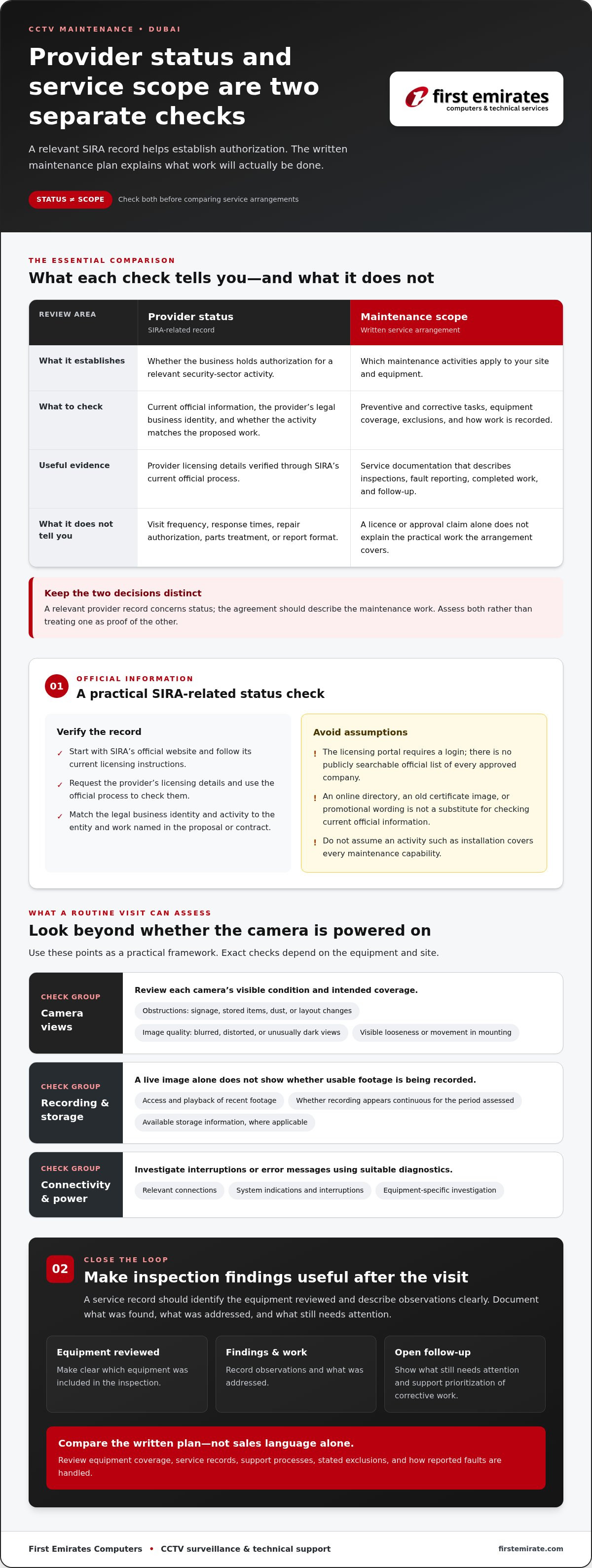
A status check establishes what a provider is authorized for; a maintenance-scope review establishes what the service arrangement actually covers. Both matter when assessing fit. This distinction is especially useful when comparing a SIRA approved CCTV maintenance company Dubai businesses are considering with other technical service options.
How to check SIRA-related provider information
Start with SIRA’s official website and follow its current licensing instructions. The licensing portal requires a login, and there is no publicly searchable official list of every approved company. An online directory, an old certificate image or a provider’s promotional statement is not a substitute for checking current official information.
Request the provider’s licensing details and use the official process to verify the record. Compare the legal business identity in the record with the entity named in the proposal or contract. Check that the activity is relevant to the work being assessed and that the record is current. If a listing relates to installation, don’t assume it covers every maintenance capability. Read activity names and verification steps as SIRA presents them, not as broader claims in sales material.
What SIRA status does not tell you about maintenance
A relevant provider record and a clear maintenance plan are separate checks. The record concerns status; the agreement should describe the work. Preventive maintenance generally means planned checks to identify developing issues, while corrective maintenance addresses reported faults. The written scope should state which activities apply to your site and equipment.
A listing alone does not establish visit frequency, fault-reporting channels, response times, repair authorization, parts treatment or service-report format. These details belong in the service documentation and should not be assumed from a licence or approval claim.
- Match the licensed business identity and activity to the proposed work.
- Review the written scope for preventive and corrective tasks, equipment coverage and exclusions.
- Check how inspections, reported faults and completed work are documented.
Keep regulatory interpretations tied to current official SIRA information. Don’t infer a specific maintenance obligation from a general licensing category. Verify any rule that affects your site through official guidance. This keeps the status review separate from the practical assessment of the maintenance plan.
CCTV Maintenance Checks That Help Keep a Dubai System Operational
A useful maintenance review looks beyond whether cameras appear powered on. Check whether important views remain clear, recordings can be accessed and connected components are functioning as expected. The exact checks depend on the equipment and site, so use the points below as a practical framework rather than a universal technical procedure. For regulatory matters, refer to the official SIRA guidelines and current information relevant to the site.
Scheduled checks support system readiness; documented follow-up shows what was found, what was addressed and what still needs attention. A clear record also helps site teams identify recurring faults and decide what corrective work to prioritize.
What a routine CCTV maintenance visit can assess
Start with a camera-by-camera review of visible condition and intended coverage. Look for obstructions such as signage, stored items, dust or changes to the surrounding layout. Compare the live view with the area the camera is meant to cover, and note blurred, distorted or unusually dark images. A camera can look intact while providing an ineffective view. Also note visible looseness or movement in the mounting; any repair or adjustment should follow an appropriate technical assessment.
Check recording separately. Where the system allows, confirm that recent footage can be accessed and played back, and review whether recording appears continuous for the period being assessed. Check available storage information where applicable, taking the system configuration and retention needs into account. A live image alone doesn’t show whether usable footage is being recorded.
Connectivity and power can also affect operation. A technician may review relevant connections and system indications, then investigate interruptions or error messages using suitable diagnostics. The method depends on the equipment. Don’t assume every site has the same network setup or that a visible symptom reveals its cause.
What service records should make clear
A service record turns an inspection into useful operational information. It should identify the equipment reviewed and describe observations in terms a site representative can understand. For example, “camera view obstructed near loading area” is more useful than a general note that cameras were checked.
- Equipment or camera locations inspected, including any item that could not be assessed.
- Observed faults or changes in image, recording, storage or connectivity.
- Actions completed during the visit and the outcome, where known.
- Unresolved issues, recommended follow-up and any action still assigned to the site.
Separate confirmed findings from suspected causes. If further technical diagnosis is needed, the record should say so instead of implying that the fault has been resolved. Assigning ownership of follow-up helps prevent an open issue from being overlooked between service visits.
Businesses reviewing ongoing CCTV maintenance support can use these checks to shape a practical system-care plan. First Emirates Computers provides annual maintenance contracts and technical support for CCTV assets, with service arrangements suited to the relevant system and site.
How to Compare SIRA-Related CCTV Maintenance Providers in Dubai
A useful comparison separates evidence from promises. A claim such as “fully compliant” is sales language unless it can be matched to relevant, current status information and a defined service scope. The phrase SIRA approved CCTV maintenance company Dubai should not replace checking the specific activity, covered equipment and written service arrangements.
Apply the same criteria to each proposal. Note what can be verified, what the scope includes and what remains unspecified. This makes differences clear without relying on promotional wording to judge a service arrangement.
| Status evidence | Equipment scope | Records | Support process | Exclusions |
|---|---|---|---|---|
| Relevant activity and current provider information that can be checked against official records | Named cameras, recording equipment and related system components covered | Inspection findings, completed actions and open issues documented | Defined route for reporting faults and tracking work | Clear limits on equipment, repairs, parts or other work not covered |
Use the table as a comparison framework, not a substitute for official verification or a written agreement. If a proposal promises “complete coverage,” ask the scope to identify the equipment and tasks that phrase includes.
Which maintenance scope fits the site's requirements?
Compare scope items individually. Preventive inspections review system condition; fault diagnosis investigates reported problems; corrective work addresses identified faults; and system documentation records assets and service history. Agreements may use different labels, so focus on the specific tasks rather than the terminology.
Map cameras and recording equipment to business-critical areas, such as entrances, payment points, loading areas or shared access routes. A small office, retail site and warehouse can have different coverage needs, operating patterns and system complexity. The scope should reflect the installed equipment, important views and site operations, not just a generic checklist.
How to assess service accountability
Review how the service arrangement records work requests, inspection findings, recommendations and completed actions. The process should distinguish a resolved issue from one that remains open or needs a separate decision. Clear notes help site teams understand what happened and who is responsible for the next step.
Any response commitments should appear in the relevant service agreement. Don’t infer timing from phrases such as “prompt support,” and don’t treat a stated response commitment as a guarantee that every fault will be resolved within that period. The agreement should explain the process and its limits.
Businesses coordinating CCTV maintenance with wider technical planning may also find the overview of IT AMC services in Abu Dhabi useful when considering how ongoing maintenance can support business continuity across technical systems.
A Dubai CCTV Maintenance Checklist for Sites, Records, and Service Planning
A maintenance plan should reflect how the premises operate, not just the equipment list. An office may prioritize entrances and reception areas; a retail space may depend on views near tills and stock areas; a warehouse may need attention to loading zones and access routes. Residential properties also vary, particularly when they have shared facilities and multiple entrances. Use a repeatable site checklist to connect maintenance planning to real operational priorities.
Operating hours and access arrangements matter. A service visit may need coordination around trading, staff shifts, resident access or warehouse activity. Set out access requirements and operational constraints in advance, then record how site access will be arranged. For broader context on camera placement during system planning, see this CCTV installation guide for Abu Dhabi.
Prepare the site and system information
Before maintenance is scheduled, assemble a current inventory and concise site brief. This helps focus the technical review and gives the site representative a clear basis for tracking findings. Include the following where available:
- Camera locations and the areas each view is intended to cover.
- Recorder details and other relevant system components, including their location.
- Known faults, intermittent issues and previous service findings.
- Access arrangements for equipment locations and site operating constraints.
- Views especially important to staff, such as entrances, service counters or loading areas.
Keep previous findings with the inventory. If the same camera location has recurring image problems, the history can help distinguish a new issue from a continuing one. Share access information through the appropriate site process, and avoid putting passwords or other sensitive credentials in general maintenance notes.
Turn maintenance findings into follow-up actions
Assign an internal owner to review service reports, coordinate decisions and track open recommendations. This responsibility may sit with a facilities, operations or site manager, depending on the organization. The important point is clear ownership: technical findings should not remain in an inbox without an assigned next step.
Separate completed corrective work from items awaiting approval, parts or further investigation. Record the status, the person responsible and the next action. When the premises change, review whether new partitions, shelving, signage or access routes affect intended camera views. An established view can become less useful after a site change even if the equipment has no visible fault.
Use this checklist to prepare a practical maintenance plan with a SIRA approved CCTV maintenance company Dubai businesses are assessing, while keeping provider status separate from site-specific service planning. First Emirates Computers provides CCTV surveillance systems and annual maintenance contracts, with technical support across the UAE. Explore CCTV maintenance support for ongoing system care aligned with your site and operational needs.
How First Emirates Computers Supports CCTV Maintenance Across the UAE
CCTV needs attention after installation as well as during system planning. First Emirates Computers provides CCTV surveillance systems, annual maintenance contracts and ongoing technical support for clients across the UAE. This gives businesses a way to manage CCTV assets over time, treating maintenance as continuing system care rather than a one-time installation task.
For businesses assessing a SIRA approved CCTV maintenance company Dubai, provider status and service capability are separate considerations. Check relevant status through current official information, then assess the proposed maintenance scope, records and operational fit for the site. First Emirates Computers provides CCTV systems and maintenance support as part of its technical services across the UAE.
What a structured maintenance relationship can support
An annual maintenance contract can provide a framework for ongoing CCTV support. Its practical value depends on having a defined way to review system condition, record findings and track issues that may require further action. Clear documentation helps site teams understand what equipment was assessed, what work was completed and what remains open. It supports better oversight without implying that every fault can be prevented or resolved immediately.
Some CCTV concerns may also involve surrounding infrastructure. Where relevant to the installed system, ELV and structured cabling capabilities can inform maintenance planning. For example, a camera issue may need to be considered alongside its cabling or the broader site setup, rather than treated as an isolated device problem. The appropriate scope depends on the equipment and the site’s operating needs.
Next steps for Dubai businesses
Prepare a concise system inventory before discussing maintenance needs. Include camera locations, recording equipment, known issues, important views and relevant access arrangements. Add recent service records if available. This gives the discussion a practical starting point and connects the maintenance scope to the site’s actual CCTV assets.
Use a consistent decision sequence: verify relevant provider status through official information, define the equipment and maintenance tasks in scope, assess how findings and completed work will be recorded, then agree how open issues will be followed up. Keep status evidence distinct from the service agreement. The first relates to provider information; the second should describe the work and support process for the system.
First Emirates Computers is a locally owned limited liability company founded in 2011, providing CCTV surveillance, annual maintenance contracts and related technical services across the UAE. For a site-specific discussion about ongoing CCTV care, discuss CCTV maintenance support with First Emirates Computers.
Put Your CCTV Maintenance Plan Into Action
Turn your site’s priorities into a practical maintenance plan. Note which views matter most, what operational constraints affect access and how your team will track findings that need follow-up. This gives you a clear basis for discussing service scope and assessing whether a SIRA approved CCTV maintenance company Dubai businesses consider fits your operational needs. Treat provider status and service commitments as separate checks.
A focused discussion can connect your system inventory and current concerns with an appropriate maintenance approach. First Emirates Computers provides CCTV surveillance systems and annual maintenance contracts, with ongoing technical support for clients across the UAE.
Discuss CCTV maintenance support with First Emirates Computers and take a clear next step toward organized, ongoing care for your CCTV system.
Frequently Asked Questions
What does SIRA approval mean for a CCTV maintenance company in Dubai?
SIRA-related approval or licensing indicates that a company has a recorded status for a particular security activity, subject to the current official record. It isn’t a general measure of workmanship or a guarantee of maintenance results. When assessing a SIRA approved CCTV maintenance company Dubai, check that the activity and business identity are relevant to the work, then evaluate the actual service arrangement separately.
How can I check whether a CCTV company is SIRA approved?
Use SIRA’s current official licensing information rather than relying only on a website badge or proposal wording. The licensing portal requires a login, and there is no public searchable directory of all approved companies. Request the provider’s licensing details and follow SIRA’s current verification process. Match the listed business identity and relevant activity to the entity named in the quotation or agreement.
Does SIRA approval cover CCTV maintenance as well as installation?
Not automatically. Approval or licensing relates to the activity recorded by SIRA, so an installation-related activity shouldn’t be assumed to cover maintenance work. Check the current official activity information and assess the maintenance agreement on its own terms. For example, confirm whether the arrangement covers your installed cameras and recording equipment rather than relying on a broad statement that the company handles CCTV systems.
What should a CCTV maintenance contract include?
A useful contract should identify the system or equipment covered, distinguish planned inspections from fault-related work and state what is excluded. It should explain how to submit a work request, how findings and recommendations are recorded and how follow-up is handled. If parts, repairs or additional work need separate approval, the agreement should explain that process so site teams can plan responsibilities and decisions.
How often should CCTV systems be maintained in Dubai?
There isn’t one maintenance interval that suits every CCTV system. Set a schedule based on the equipment, site conditions, operating needs, system documentation and any applicable current requirements. A warehouse with changing stock layouts may need attention to camera views after site changes, while an office may plan checks around access and business operations. Review the interval when the system or premises change.
What should a CCTV maintenance report show?
A report should make the service visit traceable and useful to the person responsible for the site. It can identify the visit date, locations assessed, access limitations, observations, work performed and outstanding recommendations. If an issue affects a business-critical view, describe the operational impact in plain language. This helps managers prioritize follow-up and compare later findings without treating an unresolved fault as closed.
Can a CCTV maintenance company support systems across multiple UAE sites?
A maintenance arrangement can cover multiple sites when its scope identifies each location and the equipment managed there. First Emirates Computers provides ongoing technical support for clients across the UAE. For a multi-site plan, organize a separate system inventory and contact or access details for each property, then define how site-specific findings and open actions will be tracked across the organization.


