

For commercial access control installation Abu Dhabi businesses need a plan shaped by how each door is used, who needs to enter, and which areas require tighter control. Choosing readers before mapping those needs can leave key decisions about permissions, cabling, ELV coordination, and installation work unresolved.
A practical system controls entry without making everyday operations harder. Start by listing the people who use each entrance, the access method that suits each door, and any work-hour or site constraints. Plan for administrator handover and ongoing maintenance at the same time, rather than treating them as afterthoughts.
This guide explains how commercial access control is assessed, planned, installed, and prepared for daily use. It covers access methods for different users and restricted areas, how devices relate to structured cabling and ELV infrastructure, and what to consider for maintenance after installation. First Emirates Computers provides and installs biometric access control, alongside ELV implementation, structured cabling, and annual maintenance contracts for commercial sites in Abu Dhabi and across the UAE.
Key Takeaways
- Define the access policy first by mapping staff movement, visitor routes, and restricted areas to specific entrances.
- Plan commercial access control installation Abu Dhabi around door type, entry volume, user roles, and existing cabling infrastructure.
- Compare cards, biometrics, PINs, and mobile credentials by convenience and how each method fits your credential-management process.
- Prepare for installation by documenting business hours, sensitive areas, user groups, and suitable site access windows.
- Include testing, handover, and maintenance planning so the system is ready for daily operation and ongoing support.
What Commercial Access Control Installation in Abu Dhabi Should Achieve
Commercial access control installation Abu Dhabi projects should begin with a clear operational purpose: deciding who can enter particular areas and under what permissions. A system should reflect how the business uses its premises, rather than applying the same entry arrangement to every door. Staff, visitors, contractors, and delivery personnel may need different routes or levels of access.
Controlled entry can organise staff movement, define visitor access, and limit entry to areas such as offices, stockrooms, or equipment spaces. The objective is not simply to secure the main entrance. It is to set permissions that make sense across the site and support routine work without creating unnecessary barriers.
Access control and CCTV have related but distinct roles. Access control manages entry permissions at controlled doors; CCTV supports visual surveillance of selected areas. A business may use both, but cameras do not determine who is authorised to enter. The broader concept of Access control also includes how identities, permissions, and protected resources are managed.
Which commercial sites can benefit from managed entry?
Offices, retail premises, warehouses, and multi-tenant buildings can all have different access requirements. An office may need a shared entrance for staff and a separate permission for a records room. A retail site may distinguish employee-only areas from the customer floor, while a warehouse may control access to loading areas and storage zones. In a multi-tenant property, shared entrances and tenant-specific areas add another layer of complexity.
Before defining the scope, map user groups and entry points. For each door, note who uses it, what area it leads to, and whether permissions should differ. This helps identify visitor routes, staff-only spaces, and entrances that need separate arrangements.
- User groups: staff, visitors, contractors, and other regular site users.
- Entry points: shared entrances, internal doors, and access routes to specific areas.
- Restricted spaces: rooms or zones that require different permissions from general work areas.
What belongs in a commercial access control system?
A commercial access control system manages entry through controlled doors, readers, credentials, and permissions. A credential is what a user presents or uses to request access; the reader receives it, and the assigned permission determines whether entry is authorised. The configuration depends on the premises’ layout and operating requirements.
For example, a shared entrance may serve a broad staff group, while an internal door may be limited to selected users. Define these distinctions before setting the equipment and installation scope. Clear entry rules make the system easier to use and administer.
First Emirates Computers provides and installs biometric access control in Abu Dhabi, alongside ELV project implementation and structured cabling for commercial security infrastructure. The entry plan can be shaped around the site, its users, and the areas that need different levels of access.
How Commercial Access Control Installation Moves from Survey to Handover
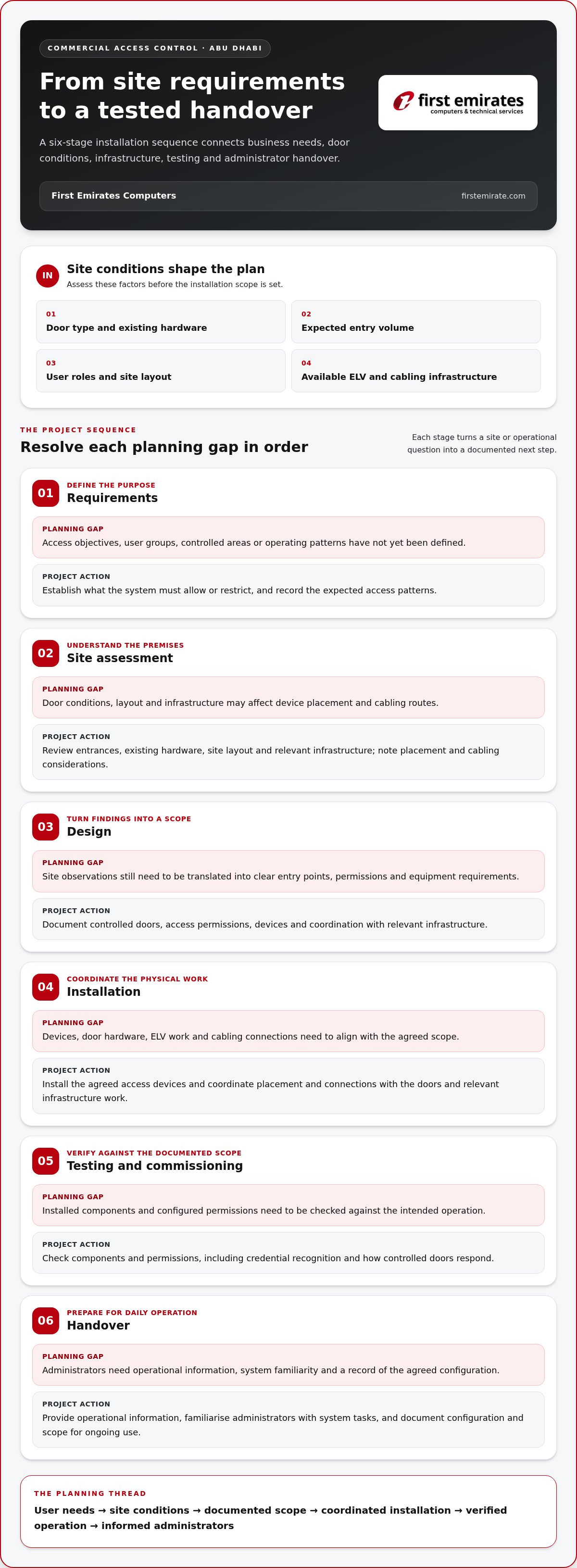
A well-managed commercial access control installation Abu Dhabi project follows a clear sequence, from defining business requirements to handing over a tested system. This helps business, facilities, and technical teams agree on which doors will be controlled, how users will enter, and how the work relates to existing doors and infrastructure.
Planning depends on practical site conditions: door type and hardware, expected entry volume, user roles, layout, and available ELV and cabling infrastructure. These factors influence device placement and the work required at each controlled entry point. The NIST Assessment of Access Control Systems provides background on access-control system structures and concepts; a commercial plan still needs to reflect the physical premises and agreed operating requirements.
- Requirements: Establish access objectives, user groups, controlled areas, and expected operating patterns. Record what the system must allow or restrict.
- Site assessment: Review entrances, doors, existing hardware, layout, and relevant infrastructure. Note conditions that may affect device placement or cabling routes.
- Design: Translate the assessment into a documented scope covering controlled entry points, access permissions, devices, and infrastructure coordination.
- Installation: Install the agreed access devices and coordinate placement and connections with door hardware and relevant ELV or cabling work.
- Testing and commissioning: Check installed components and configured permissions against the documented scope, including how credentials are recognised and controlled doors respond.
- Handover: Provide operational information, familiarise administrators with system tasks, and document the configuration and agreed scope for ongoing use.
What happens during a site assessment and design?
The assessment turns site observations into decisions that can be reviewed before installation begins. Map every entrance and controlled door, mark restricted zones, and identify expected user groups. Then consider device positions, possible cabling routes, and how the door hardware affects the installation. A documented scope gives business, facilities, and technical stakeholders a shared reference for the planned work.
Record confirmed requirements separately from items that need coordination, such as access to work areas or dependencies on existing infrastructure. This makes it clearer which doors are included and what permissions the system is intended to support.
How are installation, testing, and handover handled?
During installation, the agreed devices and associated components are fitted and configured for the site’s defined access rules. Commissioning checks that the result matches the scope: credentials are recognised, permissions correspond to assigned user roles, and each controlled entry point operates as intended. Record and address any discrepancy before the system is treated as ready for routine use.
Handover should leave the responsible team with practical information, including administrator familiarisation and operational documentation. First Emirates Computers brings biometric access control, ELV implementation, and structured cabling capabilities together for commercial projects. Information about commercial access control installation is available from First Emirates Computers.
Which Access Methods and System Approach Fit Your Abu Dhabi Business?
The right access method depends on how people use the site, how permissions will be administered, and what the access policy needs to achieve. For commercial access control installation Abu Dhabi businesses should compare credentials against real operating requirements, including staff turnover, visitor procedures, and the sensitivity of restricted areas. No single method suits every door or user group.
How should businesses compare access credentials?
Consider who will issue credentials, how access should change when roles or personnel change, and whether visitors need temporary or supervised entry. The comparison below outlines general differences. Actual capabilities depend on the selected system and its configuration.
| Method | User convenience | Credential administration | Possible fit |
|---|---|---|---|
| Cards | Users present a physical card at the reader. | Cards can be issued, reassigned, or cancelled according to the system’s administration process. | Staff groups with established credential-issue procedures. |
| Biometrics | Users identify themselves using a registered biometric credential. | Enrolment and removal need to follow the organisation’s defined procedures. | Areas where the access policy calls for identity-based entry. |
| PINs | Users enter a code at the access point. | Codes need controlled distribution and management, particularly when users or access requirements change. | Doors or user groups where code-based entry fits the policy. |
| Mobile credentials | Users present a credential through a compatible mobile device and system. | Administration depends on how credentials are assigned and managed in the system. | Sites whose users and operating procedures support device-based credentials. |
Use these criteria to weigh convenience against administration. If staff changes are frequent, consider how quickly the process allows credentials to be removed or reassigned. Visitor access may need a different procedure from regular staff entry, while a restricted room may require a more specific permission policy. Biometric access control is one option; its suitability depends on site requirements and how user enrolment will be managed.
When does a site need a broader managed system?
A limited number of doors serving simple, distinct user groups may suit a more limited arrangement, depending on system design. Where several areas share users or need coordinated permissions, central administration can make access management more consistent. Reporting requirements may also influence the approach if the selected system supports the records needed.
Keep the scope clear. Access control manages entry permissions; workforce attendance is a separate operational requirement and should only be included if the project calls for it. This distinction helps avoid adding features that do not serve the site’s entry policy.
Installation does not have to be planned as one uninterrupted site-wide activity. If business operations require it, work can be scheduled by area or controlled door. The sequence depends on site access, infrastructure, and the agreed scope, so identify operational constraints during planning rather than assuming disruption can be eliminated.
How to Prepare Your Commercial Site for Access Control Installation
Good preparation gives the project team a clearer picture of the premises, daily routines, and infrastructure before installation planning is finalised. For commercial access control installation Abu Dhabi businesses can make planning more focused by collecting site information and coordinating the people responsible for facilities, security, and affected departments. This groundwork helps surface practical constraints early, before work reaches a controlled entrance.
What site information should the project team organise?
Start with a floor plan or a clear door-by-door list. Mark shared entrances, staff-only doors, sensitive areas, and visitor routes. Then record who needs access to each area and how visitors are currently received or escorted. These details distinguish routine entry from access that requires a different permission level.
- Entrances and doors: Note each entry point under consideration and its purpose, including shared or service entrances.
- Areas and permissions: Identify restricted rooms or zones and the user categories that need access to them.
- Visitor flow: Describe reception procedures, visitor routes, and any points where entry is supervised.
- Existing infrastructure: Gather available information about ELV systems, structured cabling, and related security infrastructure within the project scope.
- Operating constraints: Record normal business hours, busy periods, sensitive activities, and acceptable access windows for installation work.
Treat existing cabling and security infrastructure as information for assessment, not as proof that every planned device can use it. Available drawings and clear notes help the project team understand what is in place and where further site review is needed. For a structured overview of factors involved in evaluating an approach, see the commercial access control selection guide.
How can businesses reduce avoidable operational disruption?
Coordinate proposed work areas and access windows with facilities staff and department leads before work begins. They can identify busy doorways, sensitive operations that need to continue, and staff who should be told about changes to normal routes. Include these constraints in the project plan.
If work affects an active entrance, agree on a temporary entry procedure for that door where needed. Depending on the premises and work sequence, users could be directed to another available entrance or a supervised route. Make responsibilities and communication clear so staff and visitors know what to do.
Phased installation can be considered when a site has several controlled areas or needs to keep some entrances operational while work proceeds elsewhere. The appropriate sequence depends on the layout, infrastructure, and agreed scope, so plan around the site’s actual operating needs rather than treating it as a fixed schedule. First Emirates Computers provides commercial installation planning for access control requirements.
Commercial Access Control Installation and Ongoing Support from First Emirates Computers
Access control needs to work as part of the wider site, not as an isolated device installation. First Emirates Computers is an Abu Dhabi-based provider of biometric access control and security systems, with ELV project implementation and structured cabling services for commercial requirements. This combination supports planning controlled entry points alongside the infrastructure included in the project scope.
For commercial access control installation Abu Dhabi businesses can begin by defining which doors need control, who uses them, and how permissions should be administered. Those requirements guide decisions about access devices, door hardware, cabling, and coordination with existing systems. The project scope should reflect the site’s layout and operational needs, rather than assuming every premises requires the same arrangement.
How do access control and ELV capabilities work together?
Access control devices need to be planned alongside the doors they control and the infrastructure that supports them. Structured cabling and ELV work can form part of the project where required by the site and agreed scope. Document existing systems and integration needs so technical planning stays connected to business operations. For wider context on network infrastructure, see structured cabling services in Abu Dhabi.
Coordination matters during design as well as installation. A controlled door may involve decisions about device placement, cable routes, and the relationship between access equipment and door hardware. Reviewing these elements together helps define a coherent scope and clarify how access control fits within broader ELV requirements.
Why plan for system maintenance after installation?
Installation and ongoing maintenance serve different purposes. Installation establishes the agreed system and configuration; planned maintenance provides a framework for attention to the system after handover. It can support routine oversight of access control equipment and give the business a defined basis for maintenance planning, without implying a particular response time or guaranteed outcome.
First Emirates Computers offers annual maintenance contracts, making maintenance a continuity consideration to include alongside handover planning. Businesses can decide what operational information administrators need and how maintenance responsibilities fit into internal processes. For a broader view of business technology upkeep, read about IT AMC services in Abu Dhabi.
A clear project brief brings together entry requirements, site infrastructure, installation scope, and post-handover support. First Emirates Computers provides biometric access control, ELV implementation, and structured cabling for commercial projects in Abu Dhabi and across the UAE.
Set a Clear Starting Point for Your Site
Turn your access priorities into a brief your facilities and security teams can act on. Identify who will own access decisions, which operational changes could affect permissions, and how the system should be reviewed after handover. This gives the project a practical starting point and keeps installation planning connected to the way your business operates.
For commercial access control installation Abu Dhabi businesses can work with First Emirates Computers, an Abu Dhabi-based specialist in biometric access control, ELV project implementation, and structured cabling. Annual maintenance contracts are available across the UAE to support ongoing system planning.
Discuss your commercial access control installation with First Emirates Computers and take the next step towards an access plan shaped around your premises and business needs.
Frequently Asked Questions
How long does commercial access control installation take in Abu Dhabi?
There is no standard duration for commercial access control installation Abu Dhabi projects. The schedule depends on the number of doors, site layout, existing infrastructure, and agreed scope. Assessment, cabling work, device installation, configuration, and testing can each affect the plan. Coordinate site access with facilities and operational teams, and identify busy periods or entrances that need special arrangements.
Can access control be installed while a business remains operational?
Yes, installation can be planned around an operating business, although the workable approach depends on the premises and scope. Facilities teams can identify doors that must remain available, while department leads can flag periods when nearby work would be disruptive. Agreed work windows, temporary entry procedures, or phased activity may help manage affected areas. Assess these options for the actual site rather than treating them as a guarantee of uninterrupted operations.
What types of commercial access credentials are available?
Common options include access cards, biometric identification, PINs, and mobile credentials. They differ in how users present credentials and how administrators issue, change, or remove access. A visitor process may need to differ from employee access, while staff turnover makes credential removal procedures important. Compare each option against your user groups, daily routines, and access policy instead of assuming one method fits every door.
Can access control work with existing doors and cabling?
Compatibility depends on the existing door hardware, cabling, and other site conditions. A site review can document the infrastructure in place and how it relates to planned access points. Older cabling or a door with particular hardware, for example, may affect device placement or the work required. State which existing components have been assessed in the project scope rather than assuming they can all be reused.
Is biometric access control suitable for every commercial business?
No. Biometrics can suit a site’s access policy, but it is not automatically the best choice for every business or user group. Consider how enrolment and access changes will be administered, whether users can follow the required process, and what alternative entry procedure is appropriate if a user cannot use the selected credential. Cards, PINs, or mobile credentials may suit other situations. Base the decision on operational needs and controlled areas.
What information should I prepare before requesting an access control installation?
Prepare a simple site brief with a floor plan or door list, the purpose of each entrance, and the teams or user groups that need access. Add visitor procedures, operating hours, areas with different permission needs, and known ELV or cabling infrastructure. Note who can provide facilities information and who will administer access after handover. This brief helps establish the project’s starting scope without requiring you to select devices in advance.
Does commercial access control replace CCTV surveillance?
No. The systems serve different functions: access control manages permission to enter, while CCTV provides visual surveillance. A business may use access permissions to control entry to a staff-only room and CCTV to observe a selected area. Having both does not automatically mean they are integrated; that depends on the project requirements and system design. Define entry management and surveillance as separate objectives when setting the scope.


