

A convenient replacement for a lost access card can create a different management challenge if it doesn’t suit the people using the door. For UAE facilities comparing alternatives to traditional key card systems UAE, the right option depends on access risk, user workflows and the infrastructure already in place.
Cards are familiar and quick to use, but lost, shared or unreturned credentials can make access administration harder. That doesn’t mean every facility needs the same replacement. Biometric readers, mobile credentials, QR codes and PIN keypads each bring different security and usability trade-offs. The right choice also depends on how permissions are issued, changed and removed.
This guide compares the options by security needs, user experience and operational fit, so you can identify suitable methods for employees, visitors and restricted areas. It also explains why door hardware, controllers, cabling and system integration matter when planning a change. First Emirates Computers provides biometric access-control solutions and ELV implementation to support facilities planning a considered transition and ongoing system maintenance.
Key Takeaways
- Compare biometric, PIN, mobile and QR credentials by how users verify their identity and where each method fits operationally.
- Assess alternatives to traditional key card systems UAE facilities can use against security needs, visitor patterns and administration capacity.
- Review existing readers, controllers, locks, cabling and integrations before selecting a replacement credential.
- Plan a controlled transition by documenting access permissions and dependencies, then piloting changes before a wider rollout.
- Consider biometric access control alongside ELV and structured cabling requirements when planning an integrated system.
Why UAE businesses are reconsidering traditional key card systems
Traditional card access uses a credential, a reader, a controller and an electronic locking mechanism. A user presents a card or fob to the reader; the controller checks its permissions and signals the door hardware to grant or deny entry. These parts work together as an access-control system, as outlined in this overview of access control systems.
Cards and fobs remain familiar in offices, residential buildings and commercial sites. They can be a practical way to assign permissions, but the administration behind them matters. Staff changes, missing credentials and delayed updates can all add work. A useful review of alternatives to traditional key card systems UAE facilities may adopt starts by identifying the specific problem, rather than assuming cards are inherently unsuitable.
Keyless access control manages entry without relying on a conventional physical card or fob. It uses another credential to verify permission, while still relying on readers or other verification devices, controllers and door hardware as required by the system design.
What traditional key cards do well, and where friction appears
Cards are straightforward to issue and familiar to regular users. Administration involves assigning permissions, recording who holds each credential, retrieving cards when access ends, and cancelling credentials that are lost or no longer needed. This work becomes harder when requests are handled manually or records aren’t kept current.
Separate process gaps from technical limitations. If an employee leaves but their card remains active because no one submitted a cancellation request, the weakness may be in offboarding procedures. If a reader, controller or lock behaves inconsistently, the issue may lie in the installed system. Changing the credential alone won’t necessarily fix hardware or integration faults.
When should a UAE facility review its access credentials?
Consider a review when lost-card incidents recur, staff access changes frequently, or administrators spend substantial time tracking issued credentials and permissions. A single process may also be difficult to manage across different user groups. Employees may need regular access, contractors may need access tied to a defined task, visitors may need a controlled entry workflow, and restricted areas may require tighter permissions.
Map those workflows before choosing a replacement. Identify who needs access, which doors they need to use, and how permissions should change when someone’s role or visit ends. This helps show whether the main concern is convenience, credential accountability, administration or system performance.
Privacy and security obligations depend on the facility’s location and how its access process operates. UAE businesses should consider applicable federal and emirate-level requirements when reviewing credentials, particularly if a proposed method involves personal information. Also distinguish a credential change from a complete system replacement: existing readers, controllers, locks and cabling may remain suitable, or may need changes depending on compatibility and the intended design.
Four practical alternatives to traditional key card systems
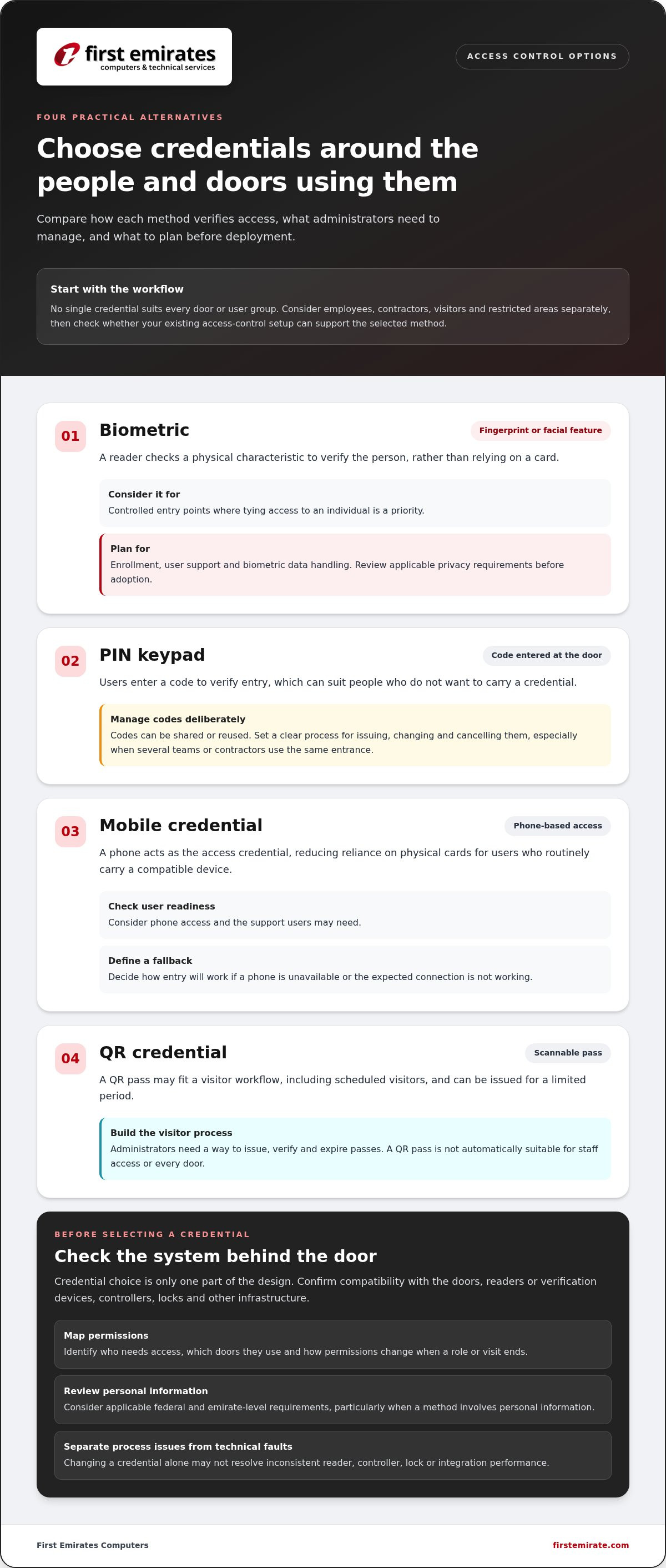
No single credential suits every door or user group. Compare alternatives to traditional key card systems UAE facilities may consider by how people prove identity, how administrators manage permissions, and what the existing access-control setup can support. These are credential categories, not guaranteed features of every system. Implementation depends on the selected equipment and its compatibility with doors, controllers and other infrastructure.
Biometric access control verifies identity using a physical characteristic, such as a fingerprint or facial feature, instead of a card. Its suitability depends on the facility’s security requirements, user workflow and approach to handling biometric information.
Biometrics and PIN keypads for controlled entry
With fingerprint or facial authentication, a person presents a biometric characteristic to a reader for verification. This can suit controlled entry points where tying access to an individual is a priority. Plan for enrollment, user support and biometric data handling, and review applicable privacy requirements before adoption.
A PIN keypad verifies entry through a code entered at the door. It can be simple for users who don’t want to carry a credential, but codes can be shared or reused. Set a clear process for issuing, changing and cancelling codes, especially where several teams or contractors use the same entrance.
Mobile and QR credentials for flexible access
A mobile credential uses a phone as the access credential, reducing reliance on physical cards for users who routinely carry a compatible device. Consider phone access, user support and fallback procedures. Decide how entry will be handled if someone’s phone is unavailable or the expected connection isn’t working.
A QR credential can provide a scannable pass for a visitor workflow, potentially for a limited period. It may fit reception areas with scheduled visitors, but administrators still need a process to issue, verify and expire passes. A QR pass is not automatically appropriate for staff access or every door.
Comparison at a glance
| Method | Convenience | Administration | Deployment consideration |
|---|---|---|---|
| Biometric | No card to carry | Manage enrollment and permissions | Review privacy, reader and system requirements |
| PIN keypad | Enter a code at the door | Control code sharing, reuse and resets | Assess code procedures and door setup |
| Mobile | Use a phone as a credential | Manage assignment and access changes | Plan for phone access, connectivity and fallback |
| QR visitor pass | Present a scannable pass | Manage issue, validity and cancellation | Fit the process to visitor entry points |
Some facilities use different methods for different users or doors rather than replacing every credential at once. First Emirates Computers provides biometric access-control solutions and can plan them alongside the facility’s door requirements and system infrastructure. Explore biometric access control planning as part of a considered credential strategy.
How to compare key card alternatives for your UAE facility
The most suitable option depends on more than the credential itself. Compare alternatives to traditional key card systems UAE facilities may consider against the level of access risk, who uses each entrance, how often visitors arrive, and how much time administrators can devote to permissions. A busy reception, a staff entrance and a restricted room may each need a different approach.
Start with the people and doors involved. Consider whether users have consistent access to a phone, whether they need an accessible and straightforward entry method, and what should happen if their usual credential is unavailable. UAE facilities have varied property and operating arrangements, so account for the site’s location and applicable requirements rather than assuming one design fits every emirate or building.
Match the credential to users and access risk
Separate permanent employees, temporary contractors, visitors and people authorised for sensitive areas. For each group, record which doors they need and how often permissions change. Prioritise straightforward administration where access changes often, while ensuring users have a practical fallback process. The appropriate method should reflect both the risk at the door and the day-to-day workflow.
A scenario-based comparison can help avoid choosing one credential for every user by default:
- Office staff: Consider a consistent credential that is easy to use for routine entry and straightforward to manage when roles change. Account for phone availability if considering mobile access.
- Contractors: Focus on clear permission boundaries and an orderly process for granting and ending access tied to their work.
- Visitors: Assess arrival frequency, reception workload and how temporary permissions will be issued and closed out.
- Sensitive areas: Give greater weight to access risk, individual accountability and the facility’s ability to administer permissions consistently.
A hybrid arrangement may be more practical than a full replacement. A facility could retain cards for one user group while applying another credential method at selected doors, provided the design and system support that arrangement. This matches the credential to each use case without making every entrance part of the same change.
Check infrastructure and integration requirements
Before selecting credentials, inventory each relevant door and its locking hardware, reader, controller, network link and cabling. Record existing dependencies, including systems that need to exchange access permissions or events. This helps identify what can remain in service, what requires adjustment, and where integration needs further assessment.
A new credential does not automatically require replacing the complete access-control installation. Compatibility depends on the existing components and proposed design, so assess them as a connected system rather than treating the reader as an isolated device. Consider the door’s location, user volume, power and network arrangements, and how the entry point is used during normal operations.
Document findings by door and user group, then compare candidate methods against the same criteria: security needs, usability, administration effort, fallback access and infrastructure fit. This structured review gives facility teams a clearer basis for choosing where to retain cards, introduce an alternative or plan a broader system change.
Plan a secure transition from key cards without disrupting operations
Changing access credentials affects people, doors and established routines, so plan the transition as a controlled project rather than a reader swap. For facilities assessing alternatives to traditional key card systems UAE sites can use, the priority is continuity: authorised users need a clear way to enter while permissions, equipment and procedures are updated.
Assess the current system before changing credentials
Build an accurate baseline before choosing a changeover approach. Record doors, access groups, cardholders, credential volumes and recurring administration issues. Map each door’s reader, controller, lock, network connection and cabling, along with connected systems or operational dependencies. Define project requirements in practical terms, such as maintaining access for authorised users during the transition and retaining the access information administrators need.
Use that baseline to guide a phased plan:
- Audit access: Confirm who holds credentials, which doors they can use, and whether permissions reflect current roles. Identify unreturned cards and gaps in the existing records.
- Set requirements: Document the access workflow for each user group and door. Specify operational priorities, reporting needs, dependencies and how temporary access will be handled during the change.
- Plan the design: Assess the proposed credential method against existing readers, controllers, locking hardware and cabling. Identify any required integration work, and define responsibilities for permission changes and user support.
- Pilot a representative entry point: Test the selected method at a door that reflects normal use, with a representative user group. Observe entry procedures, administrator tasks and any issues that could affect continuity.
- Roll out in phases: Schedule permissions migration and user communication around site operations. Explain what users need to do, provide administrator training, and establish temporary access arrangements for people affected by each phase.
- Review and refine: After installation, review access records, user feedback and the agreed project requirements. Resolve issues identified in the pilot or rollout before extending the approach to further doors.
Roll out alternatives in controlled phases
A pilot should test both the technology and the working process. Check that intended users can follow the entry procedure, administrators can apply permissions correctly, and a fallback arrangement is understood if a credential or device is unavailable. Use what you learn to adjust guidance, configuration or rollout timing before expanding deployment.
Keep a change log of updated permissions, migrated users, tested doors and outstanding issues. This gives administrators a shared reference and helps distinguish a user-training gap from an equipment or integration issue. Avoid retiring existing credentials until replacement access has been tested and changeover responsibilities are clear.
First Emirates Computers provides biometric access-control solutions, ELV implementation and structured cabling for access projects. Discuss your access-control project and plan a transition around your facility’s doors, infrastructure and operating requirements.
How First Emirates Computers can support access-control planning in the UAE
Choosing among the alternatives to traditional key card systems UAE facilities may consider is only one part of planning. The credential must work within the wider access-control design, including doors, locking hardware, controllers and supporting infrastructure. First Emirates Computers is an Abu Dhabi-based specialist in biometric access control and implements ELV projects and structured cabling across the UAE.
For commercial and residential properties, First Emirates Computers plans tailored security system installations around project requirements. This wider perspective connects credential decisions with the physical door setup and relevant infrastructure, rather than treating a new reader as a standalone change. For additional selection considerations, the access control system comparison and selection guide provides a companion resource for assessing system needs.
Connect credential decisions with the wider security system
Biometric access control can be one element of a wider strategy, rather than a default choice for every entrance. Planning should account for intended user groups, door hardware and the ELV infrastructure supporting the installation. Where structured cabling is involved, considering its role early helps align access-control work with the overall project layout and reduce avoidable coordination gaps.
Integration requirements also deserve early attention. A project may involve existing controllers or other systems, and compatibility depends on the specific equipment and design. First Emirates Computers plans access-control installations alongside ELV and cabling requirements, assessing system details as part of the project scope. This helps coordinate components without assuming that every credential or device works with every installation.
Support system reliability after installation
Access planning should include what happens after installation. A defined maintenance approach supports ongoing attention to the installed security system and gives facility teams a framework for raising and managing service needs over time. First Emirates Computers offers annual maintenance contracts for ongoing system support, helping businesses include maintenance in longer-term planning rather than treating installation as the final step.
Maintenance planning should reflect the system installed, its operational role and the facility’s support requirements. Access-control equipment may sit alongside other security and ELV infrastructure, so considering the wider environment can make support planning more coherent. The IT annual maintenance services in Abu Dhabi guide explains how planned support fits into business continuity considerations.
For a tailored discussion of your doors, user workflows and infrastructure, discuss your access-control project with First Emirates Computers.
Set a Clear Direction for Your Access Strategy
Before requesting a system design, turn your preferred access approach into a short decision brief. State which entrances matter most, who needs access, how permissions should change, and what administrators need to review over time. This gives stakeholders a shared reference and keeps decisions tied to actual site operations rather than preference for a particular credential.
Treat the choice as something to revisit as the facility changes. New tenants, revised working arrangements or changes to restricted areas can affect who needs entry and how access should be managed. A periodic review of access groups and procedures can help keep the design aligned with real use, without assuming every change calls for new hardware. That practical discipline is central to evaluating alternatives to traditional key card systems UAE organisations can sustain.
First Emirates Computers can help translate your requirements into access-control planning suited to your facility. Discuss your access-control requirements with First Emirates Computers and take a measured next step toward an approach that fits your operation.
Frequently Asked Questions
Can biometric access control and key cards be used together?
Yes, a system can use biometric credentials and cards together if its design and equipment support both methods. A facility might assign biometrics to selected staff or doors while retaining cards for other users. Before adopting this arrangement, define which credential applies to each access group and how administrators will manage permissions, exceptions and entry records consistently across both methods.
Is biometric access control suitable for every workplace?
No. Suitability depends on workplace access risks, user needs and the ability to manage biometric information appropriately. Consider whether users can reliably follow the verification process, what alternative entry procedure is available, and how enrollment and changes will be administered. When comparing alternatives to traditional key card systems UAE workplaces should also assess applicable privacy requirements for their location and context before selecting biometrics.
Can mobile credentials work if a user loses or changes their phone?
They can, provided the access system and its administration process support removing the old credential and assigning access to a replacement device. Treat a lost phone as an access change: report it through the designated channel, review the affected permissions and record what action was taken. Include a non-phone fallback procedure for staff who can’t use their device at the entrance.
What happens to existing access cards during a system upgrade?
Existing cards may remain in use during a phased change, be reassigned or be deactivated, depending on the new system design and credential compatibility. Keep an inventory of issued cards and their permissions before migration. Test the planned change at selected doors, and communicate clearly about when a card will stop working so users aren’t uncertain about entry during the upgrade.
Are PIN keypads secure enough for business access?
They can be appropriate when the code-management process matches the access risk. A shared code can make it difficult to identify who entered, while reused codes may remain known after a user’s access should end. Set clear rules for issuing and changing codes, limit knowledge to the intended users, and review whether keypad entry provides enough accountability for each door.
How can a business provide temporary access for visitors and contractors?
Assign temporary users permissions suited to their visit or work, and define who approves access, which doors are included and when the permission should end. For example, a contractor may need access to a designated work area, while a visitor’s route may be limited to reception and meeting spaces. Keep a record of issued credentials and include a process for ending access after the visit.


