

The Middle East security market reached a valuation of USD 7.54 billion in 2025, signaling a major shift in how regional businesses view protection. Security is no longer a standalone cost center; it's a strategic investment in operational intelligence. You likely understand the frustration of managing multiple separate apps and interfaces while dealing with delayed response times caused by fragmented data. Maintaining legacy systems alongside new technology often feels like a constant battle against complexity. Professional security system integration services provide the structured framework needed to resolve these daily technical friction points.
This technical guide will help you master the complexities of modern security integration, from ELV infrastructure to specific UAE regulatory compliance requirements. Reliability starts with a unified view. We'll examine how a methodical approach to centralized monitoring ensures your facility remains both secure and compliant with local standards like SIRA. By the end of this reference, you'll have a clear roadmap for achieving a unified, efficient security environment that supports long-term business stability and technical readiness.
Key Takeaways
- Understand how professional security system integration services eliminate the "silo" problem by unifying CCTV, access control, and alarms into a single, managed ecosystem.
- Learn why structured cabling and Extra Low Voltage (ELV) infrastructure serve as the essential technical backbone for high-performance security networks.
- Discover how event-driven automation, such as linking biometric access control with time and attendance software, improves operational efficiency and data accuracy.
- Navigate the complexities of UAE security standards, including mandatory SIRA-approved equipment and MCC requirements for commercial compliance.
- Recognize the critical role of Annual Maintenance Contracts (AMC) in preventing system failure and ensuring maximum uptime for integrated installations.
Understanding Security System Integration: Beyond Standalone Solutions
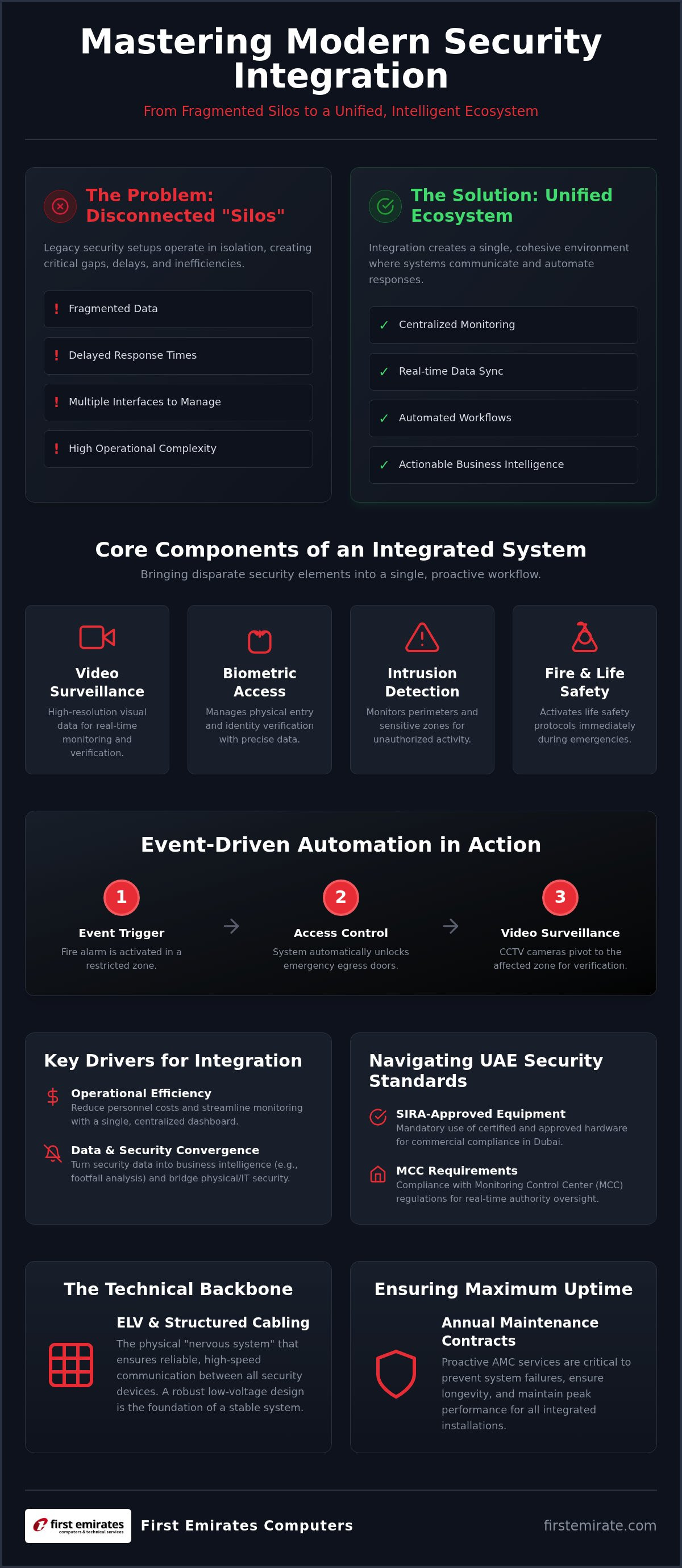
Security system integration services represent the methodical convergence of disparate hardware and software components into a single, cohesive ecosystem. Instead of treating video surveillance, biometric access control, and fire detection as isolated units, integration creates a unified environment where these systems communicate in real time. This approach moves beyond the limitations of standalone solutions, which often result in the "silo" problem. When security systems operate in silos, data is fragmented. A security breach might be recorded on CCTV, but without an automated link to the access control system, response times lag as operators manually cross-reference different interfaces. This fragmentation creates critical security gaps that modern facilities can't afford to ignore.
The transition to an integrated model involves several core components working in tandem to provide comprehensive oversight. In a non-integrated setup, these are just separate buzzers and screens. In an integrated environment, they become part of a proactive workflow. Consider the following primary elements:
- Video Surveillance: Provides high-resolution visual data and real-time monitoring.
- Biometric Access Control: Manages identity verification and physical entry points through precise data.
- Intrusion Detection: Monitors perimeters and sensitive zones for unauthorized activity.
- Fire Systems: Ensures life safety protocols are activated immediately during emergencies.
In an integrated environment, these systems allow for immediate, automated responses. For example, if a fire alarm is triggered, the system can automatically unlock specific access control points for emergency egress while simultaneously directing CCTV cameras to the affected zone for visual verification.
The Difference Between Integrated and Unified Systems
While often used interchangeably, "integrated" and "unified" refer to different architectural approaches. Integrated systems typically involve multiple third-party products that communicate through a common interface or middleware, such as Physical Security Information Management (PSIM) software. Unified systems, however, are platforms designed from the ground up by a single manufacturer to manage all security functions natively. Choosing between them depends on your facility's scale; large-scale corporate ELV projects often benefit from the flexibility of an integrated approach, while smaller sites might prefer the simplicity of a unified platform.
Key Drivers for Integration in the Modern Workplace
Operational efficiency is a primary motivator for adopting security system integration services. By centralizing monitoring, organizations reduce the personnel required to oversee multiple screens and software dashboards. This shift also enables data convergence, where security hardware provides business intelligence, such as using CCTV analytics for footfall analysis in warehouse or retail environments. Security convergence is the bridge between physical safety and IT network security, ensuring that hardware protections and digital protocols work in tandem. This methodical alignment ensures that every component of the security infrastructure contributes to a safer, more efficient operation.
The Technical Backbone: ELV Infrastructure and Unified Connectivity
The effectiveness of professional security system integration services depends on the underlying physical infrastructure. Extra Low Voltage (ELV) systems provide the technical framework that allows modern security devices to communicate without interruption. While software interfaces manage the data, the ELV layer handles the physical transmission of signals and power. Without a robust low-voltage design, even the most advanced AI-powered cameras will suffer from latency and dropped connections. This physical layer is the foundation of any reliable security ecosystem.
Structured cabling serves as the nervous system of this network. It provides a standardized architecture for data flow, ensuring that information from a biometric reader reaches the server as quickly as a video feed from a 4K camera. The adoption of Power over Ethernet (PoE) has significantly improved installation scalability. By delivering both power and data over a single cable, PoE reduces the need for extensive electrical work at every camera or sensor location. This efficiency is vital when deploying large-scale IP-based platforms across industrial sites or corporate offices.
Many facilities still rely on legacy analog equipment that remains functional but isolated. Integrating these with modern digital platforms requires a methodical approach to signal conversion and network bridging. As these systems become increasingly networked, they must align with the NIST Cybersecurity Framework to mitigate risks at the physical and digital convergence points. A secure network is only as strong as its weakest connection, which is why professional security system integration services focus heavily on hardening the physical layer against both tampering and cyber threats.
ELV System Design and Installation Fundamentals
Success in ELV security design begins with meticulous planning. Engineers must map the physical layout to ensure zero signal interference between high-voltage power lines and sensitive data cables. Redundant power supplies are non-negotiable for critical systems; they ensure that surveillance and access control remain operational during unexpected outages. For a deeper look at these technical requirements, consult our ELV System Design and Installation: A Comprehensive Implementation Guide.
Structured Cabling for High-Bandwidth Surveillance
High-resolution 4K CCTV integration demands significant bandwidth that traditional wiring cannot support. Using Cat6 or Fiber Optic cabling is essential to prevent data bottlenecks that cause video lag or loss of evidence clarity. In the server room, professional management of these lines prevents the "spaghetti" wiring that often leads to overheating and maintenance delays. Our structured cabling services UAE prioritize this level of organization for long-term reliability. If you're planning a facility upgrade, consulting with an ELV specialist ensures your infrastructure can handle future technological demands without requiring a complete overhaul.
Convergence and Automation: How Integrated Systems Transform Operations
Automation represents the operational peak of professional security system integration services. It moves the security function from a passive recording state to an active, event-driven workflow. In a non-integrated environment, an alarm is simply a noise that requires a human to investigate. In an integrated ecosystem, an alarm serves as a digital trigger. If a perimeter sensor is breached, the system automatically forces the nearest PTZ camera to a specific preset, displays the live feed on the primary monitor, and logs the entry event in the access control database. This immediate synchronization eliminates the critical seconds lost when an operator has to manually locate the correct camera feed among hundreds of options.
The role of AI and advanced analytics has become central to modern integrated surveillance. With the 2026 technical benchmarks emphasizing 4MP for general areas and 8MP for high-risk zones, the clarity of data allows AI algorithms to perform complex tasks like object classification and behavior analysis. These systems can now distinguish between a stray animal and a human intruder, significantly reducing false alarms that drain operational resources. This intelligence is particularly valuable for multi-site businesses in the UAE, where remote monitoring allows a centralized security team to manage various locations through a single, unified dashboard. Whether overseeing a corporate office or a Musaffah warehouse, managers can access real-time data and system health reports from any authorized device.
Biometric and Access Control Synergy
Integrating biometric access control with other building systems creates a frictionless entry experience while hardening the security perimeter. Face recognition technology, when linked with high-speed turnstiles, allows for rapid employee throughput without compromising identity verification. Beyond physical safety, this integration provides a direct link to time and attendance software, ensuring that payroll data is accurate and tamper-proof. Managing visitor credentials also becomes more efficient through a centralized dashboard that tracks guest movements in real time. For a deeper analysis of these technologies, refer to our Access Control System Company: A Professional Comparison and Selection Guide for 2026.
Security Technology Trends in Abu Dhabi
The UAE is seeing a rapid shift toward cloud-based integration and smart building technology. Large-scale facilities are increasingly linking their security system integration services with lighting and HVAC controls to drive energy savings. For instance, when a biometric reader logs the last person leaving a zone, the integrated system can automatically dim lights and adjust temperature settings. This convergence turns security hardware into a tool for broader business intelligence and sustainability. You can explore these evolving standards in our Workplace Security Technology Trends in Abu Dhabi: 2026 Professional Guide.
Compliance and Planning: Navigating UAE Security Standards and SIRA Regulations
Compliance in the UAE is a legal mandate that dictates every aspect of how security system integration services are designed and deployed. For businesses operating in Dubai and Abu Dhabi, systems must align with the strict standards set by the Security Industry Regulatory Agency (SIRA) and the Monitoring and Control Centre (MCC). These agencies ensure that private security infrastructure supports broader public safety goals. Using SIRA-approved equipment is mandatory for commercial integration; this hardware has been verified to meet specific technical benchmarks. For example, standard commercial installations must provide a minimum of 31 days of CCTV footage storage. For educational institutions, the requirement is 30 days. These regulations ensure that evidence remains available for investigative purposes long after an event occurs.
The audit process is a critical phase where government inspectors verify that your integrated system functions as a unified ecosystem. They look for specific configurations, such as cameras recording at 25 frames per second (FPS) to ensure video clarity. Integration makes this process more efficient by providing centralized logs that cross-reference access control events with visual data. If your system is fragmented, proving that your facility meets these rigorous standards becomes significantly more difficult. Data privacy is equally important. All security cameras must be visible to the public, and the use of hidden cameras is a major violation. Additionally, audio recording is strictly prohibited unless you obtain a specific permit from SIRA.
Step-by-Step Planning for a Compliant Integrated System
A methodical approach to planning starts with a comprehensive site survey to identify specific vulnerabilities and determine optimal hardware placement. During this phase, engineers select SIRA-approved CCTV and access control hardware that meets the 2026 benchmark of 4MP resolution for general areas and 8MP for high-risk zones. This precision ensures that your security system integration services provide the clarity required by local law. Non-compliance in Abu Dhabi can result in significant fines or licensing delays.
Specific Requirements for Musaffah Industrial Zones
Facilities in industrial zones like Musaffah face unique environmental and security challenges. Warehouse security standards in these areas prioritize high-value asset protection through the integration of perimeter fencing sensors with centralized CCTV alerts. Environmental durability is also a technical necessity. Outdoor hardware must have at least an IP66 rating to remain operational in high-heat and dusty industrial conditions. This methodical selection of hardware ensures long-term reliability and compliance in harsh environments. To ensure your facility adheres to these complex regulations, it is essential to work with a partner experienced in SIRA-approved security installations.
Selecting an Integration Partner: Reliability through Professional AMC and Support
Integrated security environments require ongoing oversight to maintain their operational integrity. A common error among facility managers is the "set and forget" mentality. They often assume that once the initial installation is complete, the system will remain functional indefinitely. However, security system integration services rely on a chain of interconnected hardware and software. If a single PoE switch fails or a firmware version becomes obsolete, the entire unified dashboard can lose critical data feeds. Professional maintenance ensures that these technical friction points are identified and resolved before they lead to a total system outage. It's about reliability.
The primary mechanism for ensuring 99.9% uptime is a structured Annual Maintenance Contract (AMC). These contracts move security from a reactive repair model to a proactive health management strategy. For businesses in the UAE, having a local Abu Dhabi partner is essential for rapid on-site response. When a biometric reader at a main entrance malfunctions, waiting days for a technician isn't an option. Local specialists provide the technical readiness required to maintain continuous operation and compliance with SIRA standards. This methodical approach to support ensures that your security system integration services continue to protect your assets without interruption as your facility grows.
The Components of a Professional IT AMC
A professional IT AMC covers more than just emergency repairs. It includes routine firmware updates to protect against new cyber threats and hardware health checks to prevent equipment degradation. Preventative maintenance for structured cabling and server infrastructure is also vital; it ensures that the physical layer remains capable of supporting high-bandwidth 4K video feeds. We focus on the details that prevent downtime. For a detailed breakdown of these protocols, see our guide on IT AMC Services Abu Dhabi: Comprehensive Maintenance for Business Continuity.
First Emirates Computers: Your Methodical Integration Partner
First Emirates Computers provides a systematic approach to ELV and security project implementation. Since our founding in 2011, we've focused on building long-term reliability through technical competence rather than temporary fixes. We specialize in SIRA-compliant installations across the UAE, ensuring that every component of your security network meets local legal requirements. Our team transitions businesses from fragmented, difficult-to-manage systems into unified security hubs that provide peace of mind through technical readiness. This methodical transition ensures your platform can grow alongside your business, supporting new hardware and software as your operational needs evolve.
Achieving Long-Term Security Resilience through Unified Infrastructure
Building a resilient security ecosystem requires a transition from fragmented hardware to a unified, data-driven platform. We've explored how the physical layer of ELV infrastructure and structured cabling provides the necessary stability for high-bandwidth surveillance. You've also seen how strict SIRA compliance and proactive maintenance through an AMC prevent operational gaps. Investing in professional security system integration services ensures your facility remains both legally compliant and technically ready for future challenges.
Success in these complex projects depends on a partner who values precision and long-term reliability. With 15 years of technical expertise in the UAE, First Emirates Computers delivers SIRA-compliant solutions backed by methodical ELV project management. We provide the steady hand needed to navigate local regulations while optimizing your facility's operational efficiency. It's about establishing trust through technical competence and comprehensive coverage.
Request a Professional Site Survey for Your Integrated Security System to begin your transition toward a more secure and centralized environment. Taking this step ensures your infrastructure is prepared for the technical demands of tomorrow.
Frequently Asked Questions
What is the main benefit of security system integration?
The primary benefit is the consolidation of separate security functions into a single, unified monitoring platform. This integration eliminates the need for staff to manage multiple interfaces, which significantly reduces response times during a security event. By centralizing data from CCTV, access control, and alarms, organizations achieve a more comprehensive view of their facility's safety status and improved operational intelligence.
Is security system integration expensive for small businesses in Abu Dhabi?
Integration is a scalable investment that can be tailored to the specific operational needs and budget of smaller enterprises. While complex enterprise-grade systems exist, many businesses start with core security system integration services that focus on essential links between CCTV and primary entry points. This methodical approach improves efficiency and reduces long-term costs associated with managing fragmented, inefficient legacy hardware.
What is SIRA approval and why does my security system need it?
SIRA approval refers to certification from the Security Industry Regulatory Agency, the government body that regulates private security in Dubai. Compliance with SIRA standards is a legal requirement for obtaining or renewing commercial licenses in many sectors. These regulations mandate specific technical benchmarks, such as maintaining 31 days of recorded footage and using high-resolution cameras that meet verified clarity standards.
Can I integrate my existing old cameras with a new access control system?
Existing analog cameras can often be integrated into modern systems through the use of digital encoders or hybrid network video recorders. This allows businesses to leverage their current hardware investments while upgrading to a unified IP-based platform. A technical assessment is required to determine if your legacy equipment can communicate effectively with new biometric access control software through a common interface.
How long does a typical security system integration project take?
The timeline for an integration project depends on the scale of the facility and the complexity of the required software links. A methodical process includes an initial site survey, infrastructure design, hardware installation, and final system testing. While smaller office setups might be completed in a few weeks, larger corporate ELV projects can span several months to ensure all components are fully synchronized.
What is the role of an ELV contractor in security integration?
An ELV contractor is responsible for the design and installation of the Extra Low Voltage infrastructure that supports your entire security network. They manage the structured cabling, redundant power supplies, and connectivity layers that allow different devices to communicate. Their expertise ensures that the physical layer of the system is robust enough to handle high-bandwidth data without signal interference.
Do I need a maintenance contract (AMC) for an integrated security system?
An Annual Maintenance Contract (AMC) is essential for maintaining the 99.9% uptime required for professional security environments. Integrated systems are technically complex and require routine firmware updates, hardware health checks, and preventative maintenance. Having a dedicated support agreement ensures that any technical friction points are resolved quickly by a local specialist before they lead to system failure or compliance issues.
Can integrated security systems be managed remotely via mobile apps?
Modern security system integration services allow for comprehensive remote management through secure mobile applications and web interfaces. Authorized personnel can view live CCTV feeds, manage access credentials, and receive real-time alerts from anywhere in the UAE. This capability is particularly useful for multi-site businesses that need a centralized, real-time view of their operations across different geographic locations.


