

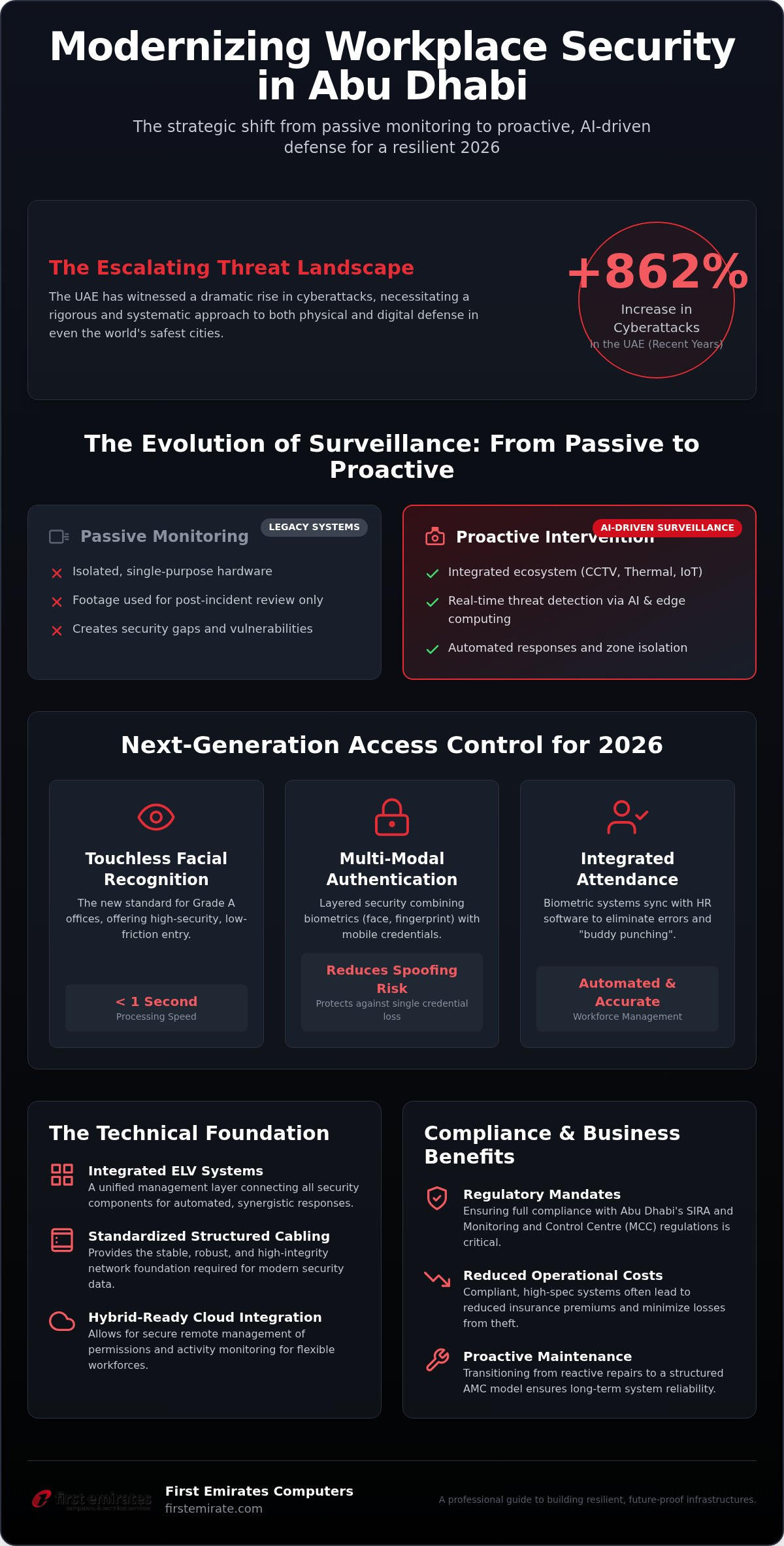
With cyberattacks in the UAE increasing by over 862 percent in recent years, even the world's second safest city requires a rigorous, systematic approach to physical and digital defense. You likely recognize that maintaining a secure office environment in 2026 involves more than just basic monitoring. It's about staying ahead of sophisticated risks while remaining fully compliant with local authorities and SIRA regulations. This professional guide provides a methodical overview of the latest workplace security technology Abu Dhabi businesses use to build resilient, future-proof infrastructures that protect both assets and personnel.
We will examine the transition from passive monitoring to proactive, AI-driven surveillance systems and the seamless integration of biometric access control with attendance management. This article outlines the technical requirements for modern ELV projects and structured cabling standards that ensure your facility meets all current regulatory mandates. You'll gain a clear understanding of how to bridge the gap between legacy hardware and new AI capabilities, ensuring your office remains secure and operational in a complex technical landscape.
Key Takeaways
- Understand how AI-driven surveillance is evolving workplace security technology Abu Dhabi from passive recording to real-time, proactive intervention.
- Identify the dominance of touchless facial recognition and multi-modal authentication in modernizing office access and attendance systems.
- Recognize the critical role of standardized structured cabling and integrated ELV systems in providing a stable foundation for security infrastructure.
- Gain clarity on navigating specific SIRA and Monitoring and Control Centre (MCC) regulations to ensure full compliance for your facility.
- Learn how to transition from reactive repairs to a proactive maintenance model using comprehensive Annual Maintenance Contracts.
The Evolution of Workplace Security Technology in Abu Dhabi
The 2026 security environment in the capital is defined by a shift from digital storage to cognitive analysis. Modern workplace security technology Abu Dhabi installations now function as integrated ecosystems rather than isolated hardware. Businesses are prioritizing these integrated models because fragmented security creates unnecessary vulnerabilities. A unified approach ensures that CCTV, thermal sensors, and access control systems communicate through a single management layer. This technical synergy allows for automated responses, such as isolating specific office zones when an unauthorized entry is detected.
IoT sensors play a vital role in creating these responsive environments. These devices provide granular data on room occupancy and door status, feeding information back to a central hub. There's also a significant economic impact to consider. Insurance providers in the UAE often reduce premiums for businesses that maintain SIRA-compliant, high-specification systems. Methodical security planning reduces long-term operational costs by minimizing theft and preventing the disruption of business continuity.
From Passive Recording to AI-Driven Surveillance
Traditional CCTV systems that merely record footage are no longer sufficient for modern corporate standards. Current installations utilize 4MP or 8MP cameras equipped with edge computing to identify threats at the source. This technology enables instant detection of specific behaviors, such as tailgating or unauthorized access to server rooms. The industry has moved away from post-incident forensic review toward a model of proactive intervention. AI-enabled surveillance serves as a tool for predictive threat management.
The Rise of Hybrid-Ready Security Infrastructure
Managing a hybrid workforce requires infrastructure that is both flexible and highly secure. Cloud-integrated monitoring allows Abu Dhabi business owners to manage staff permissions and review site activity from remote locations. This is particularly useful for managing flexible office hours where staff presence is inconsistent. It's essential that these systems are deployed on robust, structured networks to ensure data integrity. High-standard encryption protocols are necessary to protect distributed office networks from external cyber threats while maintaining seamless access for authorized personnel.
Advanced Biometrics and Access Control Trends for 2026
Abu Dhabi's corporate sector is experiencing a rapid transition toward biometric systems that eliminate physical touchpoints. This evolution in workplace security technology Abu Dhabi reflects a broader regional shift toward high-security, low-friction entry points. By 2026, facial recognition has become the standard for Grade A office spaces in the capital. These systems offer significant speed advantages, processing employee entry in under one second, which prevents congestion in high-traffic lobbies during peak hours.
Recent analysis of biometric technology trends suggests that the Middle East is leading in the adoption of multi-modal authentication. Instead of relying on a single identifier, businesses are combining fingerprint scans with mobile credentials. This layered approach ensures that security isn't compromised if a single credential is lost or spoofed. It's a methodical way to strengthen the perimeter while maintaining accessibility for authorized staff. Choosing the right biometric access control solution is a logical starting point for enhancing both security and operational flow.
Face Recognition and Touchless Entry
Abu Dhabi offices are moving away from physical cards primarily to enhance operational hygiene and security. Unlike RFID cards, facial templates can't be shared or stolen easily. These systems often integrate with thermal scanning and health safety protocols, providing a comprehensive screening process at the point of entry. This technical readiness is essential for maintaining a safe environment and ensuring that only authorized, healthy personnel enter sensitive work zones.
Biometric Attendance and Workforce Management
Integrating biometric attendance systems in Abu Dhabi with central HR software is a critical step for modern workforce management. This connection eliminates "buddy punching" and manual entry errors, which are common in large UAE workforces. Automated reporting features also assist businesses in maintaining strict compliance with local labor laws by providing accurate, unalterable logs of working hours. It simplifies payroll processing and ensures that attendance data is always audit-ready.
Real-time occupancy tracking is another functional benefit of modern biometrics. By monitoring exactly how many people are in a specific zone, building management systems can adjust lighting and HVAC settings to improve energy efficiency. During an emergency response, these systems provide first responders with a precise count of individuals remaining in the building. To meet UAE data protection standards, these biometric templates are stored using privacy-first encryption, ensuring that sensitive personal data remains secure and fully compliant with local regulations.
The Foundation: ELV Systems and Structured Cabling
Advanced workplace security technology Abu Dhabi installations depend entirely on the physical infrastructure supporting them. Without a robust data path, even the most sophisticated AI cameras will suffer from latency or packet loss. A methodical approach to ELV projects ensures that security, IT, and building management systems function on a single, unified network. This convergence allows for more efficient data handling and simplified oversight. It ensures that every component, from a biometric scanner to a thermal sensor, communicates seamlessly with the central server.
When installing systems in 2026, it's logical to plan for 2030 requirements. High-bandwidth applications like real-time facial recognition and high-definition video storage demand a network that won't become obsolete in three years. Professional ELV system design and installation is the only way to guarantee this longevity. Adhering to official workplace safety regulations requires a stable infrastructure that remains operational during emergencies. A well-designed backbone provides the reliability needed for critical life-safety systems to trigger correctly when every second counts.
Structured Cabling as the Security Backbone
Structured cabling acts as the central nervous system of your office. High-quality structured cabling services in the UAE provide the necessary bandwidth for 4K surveillance streams without choking the rest of the corporate network. For biometric verification, low latency is essential. Delays of even a few seconds can frustrate employees and cause lobby congestion. Choosing between fiber optic and Cat6 depends on the distance and data volume required. Fiber is generally preferred for backbone connections, while Cat6 remains a reliable standard for shorter horizontal runs to individual devices.
Integrated ELV Project Management
Managing multiple contractors for different low-voltage systems often leads to communication gaps and technical friction. A single-source ELV contractor streamlines the process by coordinating security hardware with fire alarms and PA/VA systems. This systematic project planning reduces installation downtime and ensures all components are fully compatible. It's a functional strategy that provides a complete, integrated solution for modern office environments. This approach also simplifies future troubleshooting, as a single, comprehensive map of the cabling infrastructure exists for the entire facility.
Compliance and Regulations: Navigating Abu Dhabi Standards
Compliance isn't optional for businesses in the capital. To maintain a valid trade license, your workplace security technology Abu Dhabi must adhere to the rigorous standards set by the Security Industry Regulatory Agency (SIRA) and the Abu Dhabi Monitoring and Control Centre (MCC). These bodies ensure that all surveillance and access systems meet minimum technical benchmarks for public and private safety. Adhering to these guidelines protects your business from legal liabilities and significant fines during annual inspections. It's a structured process that requires technical readiness and a deep understanding of local laws.
SIRA and MCC Certification Requirements
Surveillance systems are mandatory for specific business types, including commercial towers, financial institutions, and large-scale industrial sites in areas like Musaffah. Government inspections focus on exact technical criteria that can't be overlooked. For instance, all cameras must be in color and have a minimum resolution of 1080p. There is a strong push toward 4MP for general surveillance and 8MP for high-risk areas. If cameras are installed at a height of 4 meters or more, they must feature remote zoom and focus capabilities. Additionally, outdoor cameras require an IP66 rating to withstand the local environment. You must also maintain a minimum data retention period of 31 days for all footage to remain compliant.
Data Privacy and Video Storage Laws
Storing personal biometric data requires strict adherence to UAE privacy laws. While cloud storage is gaining popularity for its flexibility, many Abu Dhabi regulations still favor on-premise storage for sensitive security data to ensure local control and high-speed retrieval. Biometric templates must be encrypted and decoupled from personal identifiers where possible. Best practices involve limiting footage access to authorized security personnel and conducting regular audits to ensure data isn't kept longer than the legally required period. Audio recording is strictly prohibited without explicit permission from the authorities, making it vital to disable these features during the installation phase.
Navigating these complex requirements is difficult without a specialized partner. It's a technical necessity to work with a SIRA approved CCTV company in Abu Dhabi to ensure your hardware and software configurations pass government audits. A methodical installation process avoids the cost of retrofitting non-compliant equipment later. This approach ensures that your security infrastructure is both functional and legally sound from day one. If you need assistance with a fully compliant installation, you can consult our security experts to ensure your facility meets all local mandates.
Future-Proofing: Implementation and Long-term Maintenance
A high-specification security installation is only as effective as the maintenance program supporting it. Many organizations fall into the trap of reactive repairs, addressing hardware failures only after they occur. This approach creates dangerous gaps in protection and can lead to non-compliance with SIRA standards. Adopting a proactive strategy for workplace security technology Abu Dhabi ensures that every camera, sensor, and cable remains operational. It's a methodical way to protect your initial investment while maintaining a constant state of technical readiness.
System longevity depends on consistent oversight and technical support. Integrating IT AMC services in Abu Dhabi into your operational budget allows for regular health checks and hardware optimizations. Modern systems now feature remote diagnostics, which allow technicians to identify and resolve software glitches or network bottlenecks without the need for an immediate site visit. This capability reduces downtime and ensures that your security perimeter is never compromised by avoidable technical errors.
Selecting the Right Security Partner
Choosing a contractor requires more than just comparing equipment costs. You need a partner with deep local expertise in Abu Dhabi city and industrial zones like Musaffah. This local knowledge is vital for navigating specific site challenges and ensuring rapid response times for on-site support. When evaluating a potential partner, prioritize their ability to provide 24/7 technical assistance and their track record with complex ELV projects. A dependable partner acts as a long-term resource, helping you budget for future technology lifecycles and necessary software updates.
The Critical Role of Annual Maintenance Contracts (AMC)
Annual Maintenance Contracts are the foundation of a resilient security infrastructure. They provide a structured schedule for essential tasks that are often overlooked in busy office environments. Regular firmware updates are a primary focus, as they patch vulnerabilities and protect your CCTV network from evolving cyber threats. Physical maintenance is equally important in the UAE's climate. Dust and heat can degrade sensor sensitivity and cable integrity over time. A comprehensive AMC includes:
- Routine Cleaning: Ensuring camera lenses and biometric sensors are free from obstructions.
- Cable Audits: Checking structured cabling for signs of wear or environmental damage.
- Database Optimization: Cleaning up old biometric templates and ensuring the attendance software runs efficiently.
- Guaranteed Response: Establishing clear service level agreements (SLAs) for emergency repairs.
This systematic approach ensures business continuity and provides peace of mind. By moving away from the unpredictability of reactive repairs, you create a stable environment where technology serves your business without interruption. It's the most logical way to manage a complex technical landscape while staying fully compliant with all local authorities.
Building a Resilient Security Infrastructure for 2026 and Beyond
Establishing a secure and compliant office environment requires more than just high-specification hardware. It demands a systematic integration of AI-driven surveillance, biometric access, and a stable ELV backbone that meets the evolving standards of local authorities. This guide has detailed how modern workplace security technology Abu Dhabi is moving toward proactive, unified ecosystems that prioritize both data integrity and operational efficiency. Ensuring your facility adheres to SIRA and MCC regulations is a technical necessity that protects your business from legal liabilities and long-term risks.
Maintaining this infrastructure through structured maintenance is the final step in future-proofing your investment. Our Abu Dhabi-based support team provides the technical readiness required for complex installations and long-term reliability. By partnering with seasoned specialists, you can transition from reactive repairs to a disciplined model of comprehensive oversight.
Secure your workplace with First Emirates Computers’ integrated solutions. As SIRA-approved installers, we offer specialized expertise in biometric systems and comprehensive ELV and IT maintenance contracts. We look forward to helping you establish a stable and secure technical foundation for your corporate operations.
Frequently Asked Questions
What are the mandatory security requirements for new offices in Abu Dhabi?
New office builds must comply with SIRA and MCC standards, which mandate high-definition cameras with at least 1080p resolution. Requirements include 31 days of footage retention and specific camera types for indoor and outdoor environments. Outdoor cameras must have an IP66 rating to ensure durability against local weather conditions. These regulations are strictly enforced during annual trade license renewals to maintain workplace security technology Abu Dhabi standards across all commercial sectors.
How does AI improve workplace security compared to traditional CCTV?
AI-driven systems provide real-time behavioral analysis and automated threat detection, whereas traditional CCTV relies on passive recording for forensic review. Modern AI can identify unauthorized tailgating or suspicious loitering and trigger immediate alerts to security personnel. This shift from reactive to proactive monitoring significantly reduces response times. It allows security teams to intervene before an incident escalates, rather than simply reviewing footage after an event has occurred.
Are biometric attendance systems legal under UAE data privacy laws?
Biometric attendance systems are legal in the UAE provided they comply with federal data protection laws regarding personal identifiers. Organizations must ensure that biometric templates are encrypted and stored securely to prevent unauthorized access or data leaks. It's essential to inform employees about data usage and maintain a high standard of cybersecurity. Professional installers ensure these systems are configured to meet both operational needs and local privacy mandates.
What is the difference between SIRA and MCC compliance?
SIRA is the primary regulatory body setting security standards across the UAE, while the Monitoring and Control Centre (MCC) provides specific oversight for systems within Abu Dhabi. While their technical requirements for hardware often overlap, MCC focuses on the integration of commercial systems with city-wide monitoring networks. Compliance with both entities is necessary for certain business categories to ensure their infrastructure aligns with national safety and monitoring protocols.
How often should a workplace security system be maintained in Abu Dhabi?
Professional security systems should undergo comprehensive maintenance at least twice a year to ensure hardware and software reliability. An Annual Maintenance Contract (AMC) is the most effective way to manage this, as it includes regular firmware updates and physical sensor cleaning. Frequent checks prevent cable degradation and ensure that cameras remain in focus. Methodical upkeep is a requirement for passing government inspections and ensuring the longevity of the entire system.
Can I integrate my existing access control with a new CCTV system?
Most modern IP-based access control systems can be integrated with new CCTV hardware through a unified management platform. This convergence allows for video verification, where a door event triggers a specific camera to record the entry. It creates a more cohesive security ecosystem by linking physical entry logs with visual evidence. A professional contractor can assess your current cabling to determine if legacy hardware is compatible with newer AI-driven software platforms.
What is the benefit of an ELV contractor for office security?
An ELV contractor provides a single point of responsibility for all low-voltage systems, including security, IT, and automation. This approach ensures that your structured cabling is designed to support high-bandwidth surveillance without causing network congestion. It eliminates technical friction between different hardware vendors and streamlines the installation process. Systematic project management by an ELV specialist results in a more stable and scalable infrastructure for the entire corporate environment.
How much does a professional CCTV installation cost in Abu Dhabi?
The total investment for a professional CCTV installation depends on factors such as camera count, required resolution, and the complexity of the structured cabling. High-risk areas requiring 8MP cameras or remote zoom capabilities will require a different budget than smaller office spaces. To get an accurate assessment, businesses should request a site survey that considers their specific SIRA compliance needs. We recommend consulting with a certified installer to receive a technical proposal tailored to your facility.


