

Management doesn’t approve a shopping list of cameras. It approves a defined plan to reduce risk and support business operations. If you’re working out how to get security system approval from management, start by connecting the proposed system to specific site risks, operational needs and applicable requirements.
The process can involve operations, finance, IT, facilities and senior management, with each group assessing different concerns. A credible proposal addresses those concerns by setting out the risks, recommended coverage, project scope, budget considerations, installation impact, privacy controls and ongoing maintenance plan.
In the UAE, requirements can vary by emirate and site type. Dubai and Abu Dhabi have separate security-system frameworks, so identify the relevant authority and building requirements early to help avoid approval delays or scope changes. The proposal should also explain how CCTV, access control, cabling and system support work together as a practical risk-control plan.
This guide explains how to build an evidence-led business case, identify the right stakeholders and prepare for questions about cost, disruption, privacy and maintenance. It also covers the steps from management approval to a coordinated, supportable implementation.
Key Takeaways
- Separate internal management sign-off from any authority, landlord, building or site permissions required for the project.
- Build a business case around documented risks, affected locations and operational impact, then link each proposed control to a clear outcome.
- Compare a necessary baseline with an expanded option using consistent criteria such as coverage, integration, installation impact and ongoing support.
- Use a concise decision package to explain how to get security system approval from management, including the requested decision, evidence, scope and key risks.
- Plan the handover as carefully as the installation, with clear responsibilities for testing, system administration, staff instruction and maintenance.
How security-system approval works: internal permission versus UAE requirements
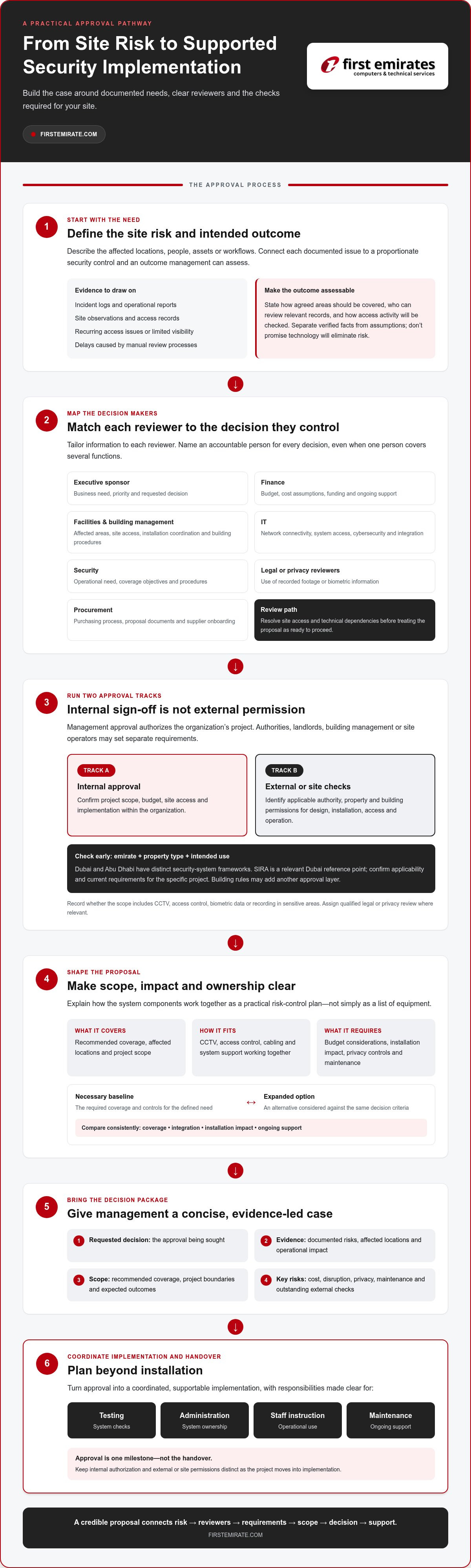
Security-system approval has two separate tracks. Management decides whether the organization will fund and implement a defined project. External authorities, landlords, building management or site operators may set separate requirements for system design, installation, access and operation. One decision does not automatically satisfy the other.
Definition: Internal approval authorizes the project’s scope, budget, site access and implementation within the organization. Regulatory or site approval covers any applicable authority, property or building permissions. Identify both tracks before treating a proposal as ready to proceed.
This distinction is central to how to get security system approval from management: prepare the internal business case while identifying external checks that could affect the design or installation. Security planning is broader than selecting equipment. The general principles outlined in Security Management Principles also emphasize managing security as an organized function.
Who may need to review a security-system proposal?
Map reviewers to the decisions they control, then tailor the information each needs. A clear review path helps prevent gaps, such as approving a budget before resolving site access or technical dependencies.
- Executive sponsor: Confirms the business need, priority and requested management decision.
- Finance: Reviews the budget, cost assumptions, funding source and ongoing support commitments.
- Facilities and building management: Assess affected areas, site access, installation coordination and building procedures. A landlord or property operator may require separate permission for equipment placement, cabling or work in shared areas.
- IT: Reviews network connectivity, system access, cybersecurity considerations and integration with existing infrastructure.
- Security: Validates the operational need, coverage objectives and procedures for using the system.
- Legal or privacy reviewers: Assess the proposed use of recorded footage or biometric information and identify questions requiring qualified review.
- Procurement: Checks the purchasing process, proposal documentation and supplier onboarding requirements.
Not every organization assigns these responsibilities to separate teams. Name an accountable reviewer for each decision, especially when one person covers facilities, security or IT.
What UAE-specific checks should be identified early?
Start with three facts: the emirate, the property type and how the system will be used. An office, retail site or regulated premises may involve different considerations, and building rules can add another approval layer. In Dubai, SIRA is a relevant security-system reference point, but confirm its applicability and current requirements for the specific project. Abu Dhabi and other emirates have distinct processes, so don't assume a requirement in one emirate applies elsewhere.
Document whether the proposal includes CCTV, access control, biometric data or recording in sensitive areas. Ask qualified legal or privacy reviewers to assess relevant privacy, recording and data-protection considerations before finalizing the scope. This helps management see which external or specialist reviews remain outstanding and assign responsibility for resolving them.
Build a management-ready business case for the security system
A business case links a defined security need to a proportionate control and explains the operational result the organization expects. It should make clear why action is being considered, what the proposed system will cover and how its performance will be assessed.
For how to get security system approval from management, avoid beginning with a list of devices. Start with the site problem and the records that show its effect. Examples include documented incidents, recurring access issues, areas with limited visibility or delays caused by manual review processes. Use incident logs, site observations, access records or operational reports where available. Separate verified facts from assumptions, and state when evidence is incomplete.
Document the need and intended outcomes
Describe the affected locations and the people, assets or workflows the proposed system would support. Then connect each issue to an outcome management can evaluate. For example, a proposal for an area with limited visibility might aim to improve incident review, while an access-control project might make entry permissions easier to manage and access activity more traceable.
Set practical measures without promising that technology will eliminate risk. Measures might include whether agreed areas have the intended coverage, whether authorized users can review relevant records and whether the process for checking access activity is clear. State a baseline where records allow it, identify who will review results and avoid targets that cannot be measured reliably.
Show the proposed scope and lifecycle responsibilities
Summarize the project in plain language before adding technical detail. Depending on the need, the scope may include CCTV surveillance, biometric access control, structured cabling, integration with existing systems and installation coordination. Clarify which locations and functions are included, along with assumptions, dependencies and exclusions. For instance, state whether the project depends on site access or existing network infrastructure instead of leaving reviewers to infer it.
Management should also understand what happens after installation. Identify who will administer user access, manage system permissions, arrange staff instruction, review records and coordinate upkeep. Include the maintenance approach and ongoing responsibilities in the decision, not as an afterthought. For access-control planning, an access-control system comparison and selection guide can help frame the evaluation criteria.
Where the project connects to information systems or handles sensitive records, include a qualified review of relevant requirements. The TDRA’s UAE Information Assurance Regulation provides a reference for assessing information-assurance considerations. Determine its applicability to the organization and project rather than assuming it applies universally.
A concise proposal can present the need, evidence, intended outcomes, scope, assumptions, dependencies, exclusions and lifecycle owner in one reviewable package. First Emirates Computers provides CCTV, access control, cabling, ELV implementation and ongoing maintenance to support clearly scoped projects. Explore a coordinated security-system project scope as you develop the technical portion of the business case.
Compare security-system options using management’s decision criteria
A useful comparison gives management a choice between scopes that address the same documented problem in different ways. Set out a necessary baseline and an expanded option, then compare them against consistent criteria. The broader option is not automatically better: additional coverage or integration is valuable only when it supports an identified need and can be operated and maintained appropriately.
The preferred option should meet the documented objectives with a proportionate scope. To make the decision clear, show the trade-offs instead of relying on technical descriptions alone.
Comparison framework
- Coverage: Baseline covers the agreed priority locations; expanded scope adds locations only where the documented need supports them.
- Access needs: Baseline addresses defined entry points and user administration; expanded scope may include more doors or additional access workflows.
- Integration: Baseline records required connections to existing systems; expanded scope adds integration only where compatibility and operational value are established.
- Installation impact: Compare affected areas, site access requirements, cabling work and coordination needs for each option.
- Support: Identify who administers users, handles routine system responsibilities and coordinates maintenance under each scope.
- Lifecycle: Separate project components, such as equipment, cabling and installation, from recurring responsibilities, such as maintenance and ongoing administration.
Which evaluation criteria matter to management?
Assess whether proposed CCTV coverage will provide the views needed for the stated operational purpose, and whether access records will support the organization’s review process. Consider how user permissions will be administered, which systems need to connect, and whether existing ELV infrastructure and structured cabling can support the proposed arrangement. Record assumptions rather than treating compatibility as automatic.
Operational ownership matters as much as installation. Identify staff instruction needs, who will manage access changes, how upkeep will be coordinated and whether the system can accommodate foreseeable site or workflow changes. These details help reviewers assess the full lifecycle, not only the initial project scope.
How should options be compared fairly?
Use the same site assumptions and evaluation criteria for each option. If one proposal includes cabling, installation coordination or maintenance and another excludes them, show the difference clearly so management is not comparing unlike scopes. List dependencies, exclusions, implementation constraints and items that require separate approval.
Separate one-time project work from recurring support responsibilities rather than blending them into a single unexplained category. Avoid claims of guaranteed outcomes. Tie technical statements to the project specifications and available evidence, and explain what remains subject to site assessment or approval. A concise comparison lets finance review lifecycle commitments, facilities assess disruption and IT consider integration without requiring every reviewer to interpret technical shorthand.
Submit the proposal and guide it through review
A complete proposal needs a clear route through review, not just a technically sound scope. Before submission, identify the decision owner, required reviewers, meeting date and exact decision requested. In the UAE, keep internal authorization separate from authority, landlord or building approvals. Confirm current requirements for the specific emirate and site, and record them as separate checkpoints rather than treating management sign-off as permission to begin work.
A practical sequence for how to get security system approval from management is:
- Align with a sponsor. Confirm the business need, priority locations and the person accountable for presenting the request.
- Prepare the approval pack. Assemble the evidence, project scope, options, risks, dependencies and requested decision in a concise format.
- Route it to reviewers. Share the relevant material with finance, facilities, IT, security, procurement and other required reviewers, allowing time for questions.
- Resolve questions in writing. Record each clarification, its supporting evidence and any resulting change to scope or assumptions. Circulate a revised version so reviewers assess the same proposal.
- Record the decision and handover. Document approval, conditions, outstanding permissions and accountable owners before scheduling implementation.
What should the approval pack contain?
Keep the main proposal readable for non-technical decision-makers, with supporting detail in attachments. Include an executive summary, problem statement, intended objectives, site scope and recommended option. Add the comparison matrix, implementation dependencies, risk notes and a responsibility summary covering administration, user access and ongoing support.
Make the decision request specific, such as approval for a defined scope and permission to proceed to the next project stage. List assumptions, exclusions and matters requiring separate approval. Record privacy and data-handling questions, including those related to footage or biometric information, for appropriate internal and external review. This helps reviewers distinguish resolved points from items that still need an accountable owner.
How can the request move efficiently through review?
Send reviewers the same version of the proposal and state what feedback or decision is needed from each. If finance questions lifecycle commitments, provide the relevant scope and support assumptions. If facilities identifies a site constraint, document its effect and present a revised approach or alternative. Avoid informal changes that leave different reviewers working from different versions.
After the decision, maintain a short record of approval conditions, unresolved questions, external or property permissions and the person responsible for each action. Management may authorize the project while an authority or building checkpoint remains open, so don't treat internal approval as clearance to schedule work until applicable prerequisites are addressed.
For a clearly scoped CCTV, access-control or cabling proposal, discuss your security-system project scope with First Emirates Computers.
Turn approval into a coordinated security-system implementation
Approval becomes useful when the authorized scope is translated into site tasks, named responsibilities and clear completion checks. Before work is scheduled, the project owner should reconcile the management decision with its conditions, site procedures and any outstanding permissions. This handover helps prevent differences between what management approved and what teams prepare to install.
What should happen before installation begins?
Confirm access arrangements, affected areas and operational schedules with the relevant site contacts. If the approved project combines CCTV, biometric access control and structured cabling, plan these activities together so site access, installation sequencing and testing align with the agreed scope. Resolve applicable authority, landlord or building permissions before work proceeds.
- Confirm the approved baseline: Use the final scope and record any conditions or exclusions.
- Coordinate site readiness: Agree access arrangements, affected work areas and operational constraints with responsible teams.
- Sequence the work: Align cabling, equipment installation and system configuration where the project includes these tasks.
- Define completion checks: Set out how the team will verify the installed system against the approved requirements and document any open items.
For a UAE site, retain a record of which external or property approvals apply and who is responsible for closing each checkpoint. If a site condition requires a scope change, document it and route it through the organization’s change-approval process before proceeding.
How can management retain oversight after handover?
Handover should leave the organization able to operate and support the system, not simply confirm that installation has ended. Assign named owners for administering users, changing access permissions and system settings, and handling operational questions. Staff who use or review the system should receive instruction appropriate to their responsibilities.
Agree what records will be handed over, who maintains them and how open issues will be tracked. Establish a review point suited to system use and operational needs. That review can consider whether the system continues to meet its approved purpose, whether user permissions remain appropriate and whether maintenance responsibilities are being carried out.
- Administration: Identify the role responsible for user accounts, permissions and configuration changes.
- Operational guidance: Document staff instruction and the route for reporting issues or requesting changes.
- Maintenance: Assign an owner to coordinate ongoing upkeep and track service records.
- Review: Set a proportionate check of system use, responsibilities and any changes in site requirements.
For planning ongoing support, the IT AMC services Abu Dhabi maintenance guide provides further context on maintenance planning and business continuity.
First Emirates Computers supports coordinated CCTV, access-control, structured-cabling and ELV implementation, with ongoing maintenance planning included where required. A clear handover keeps management, site teams and technical implementation aligned.
Move your approved proposal into its next stage
Use approval as the starting point for disciplined project ownership. Assign a person to track outstanding conditions, coordinate internal teams and keep the approved scope aligned with site requirements. This creates a clear bridge between the management decision and the work that follows.
If you’re considering how to get security system approval from management for a new site or revised project, an implementation partner can help translate the agreed objectives into coordinated project planning. First Emirates Computers is a locally owned UAE limited liability company, established in 2011, with CCTV, biometric access control, ELV implementation and structured cabling capabilities, alongside annual maintenance contracts for ongoing system support.
Bring your site needs and proposed scope into the next planning discussion. Discuss a management-ready security-system proposal with First Emirates Computers and take the next step toward a coordinated, supportable implementation.
Frequently Asked Questions
How do I write a security-system approval request to management?
Write a short decision request that states what you need management to approve and why. For how to get security system approval from management, connect a documented issue to a proposed outcome, such as improving visibility at a goods entrance or making staff access easier to review. Name the affected site areas, identify the requested decision-maker and attach technical detail separately so the main request stays readable.
What documents should I include when requesting security-system approval?
Include evidence that helps reviewers understand the site and requested change. Useful attachments may include a marked-up floor plan, relevant incident or access records, photos of areas under consideration, an inventory of existing equipment and a short description of current procedures. Add the proposal and any supplier documentation, plus a record of questions requiring privacy, IT or property review. Label drafts and revisions clearly to prevent decisions based on outdated material.
Does management approval mean a security system is legally approved in the UAE?
No. Management approval is an internal business decision, not confirmation that every applicable UAE authority, property or site requirement has been met. Requirements can depend on the emirate, premises and intended system use. For example, SIRA is a Dubai-specific reference point, but the project team should confirm current applicability and requirements for the site. Keep a separate record of external approvals and conditions, and don't schedule work until relevant prerequisites are addressed.
How can I justify CCTV or access control to management?
Show the operational issue and explain how the proposed control supports a defined task. For CCTV, you might document that a particular entrance is difficult to review after an incident. For access control, you could show that staff permissions are hard to track across restricted areas. Use available records to establish the need, then identify how the organization will assess whether the system supports review or access administration without claiming it removes all risk.
Who should approve a security-system installation in an office or commercial property?
Internal authorization usually comes from the manager or executive with authority over the project scope and funding, following reviews by relevant teams such as finance, facilities, IT, security, legal and procurement. The building owner, landlord or property manager may separately control site access and installation procedures. Applicable UAE authority requirements are another checkpoint. Identify each decision-maker for the specific premises, since responsibilities differ between organizations and properties.
Can a security-system proposal include biometric access control?
Yes. A proposal can include biometric access control where it addresses a defined access-management need. State which doors or user groups are in scope, who will administer permissions and how the system fits the site's operating procedures. Because biometric information is sensitive, document questions about purpose, collection, access, retention and handling for qualified privacy or legal review. Management can then assess the operational case alongside those data-handling considerations.
What happens after management approves a security-system proposal?
Convert the decision into a controlled project handover. Record any approval conditions, assign owners to outstanding actions and reconcile the approved scope with site access arrangements and applicable external permissions. Then coordinate installation and testing against the agreed requirements. At handover, retain system and configuration records, identify who manages users and permissions, brief relevant staff, and establish responsibility for maintenance and follow-up review.


